2 Kings 5:1–14
Let it never be said that the Bible lacks a sense of humor. Today's story is about Naaman, a Syrian captain, whose name in Hebrew means "beautiful" (masculine form of Naomi, mother-in-law of Ruth). The root occurs in Ugaritic (na`amanu) and (possibly) Amorite (nachmanu), and is the Semitic name for the deity also-known-as Adonis (Wikipedia link; note the two-fold connection of "rebirth" [killing and making alive, 2 Kings 5:7] and youthful beauty).
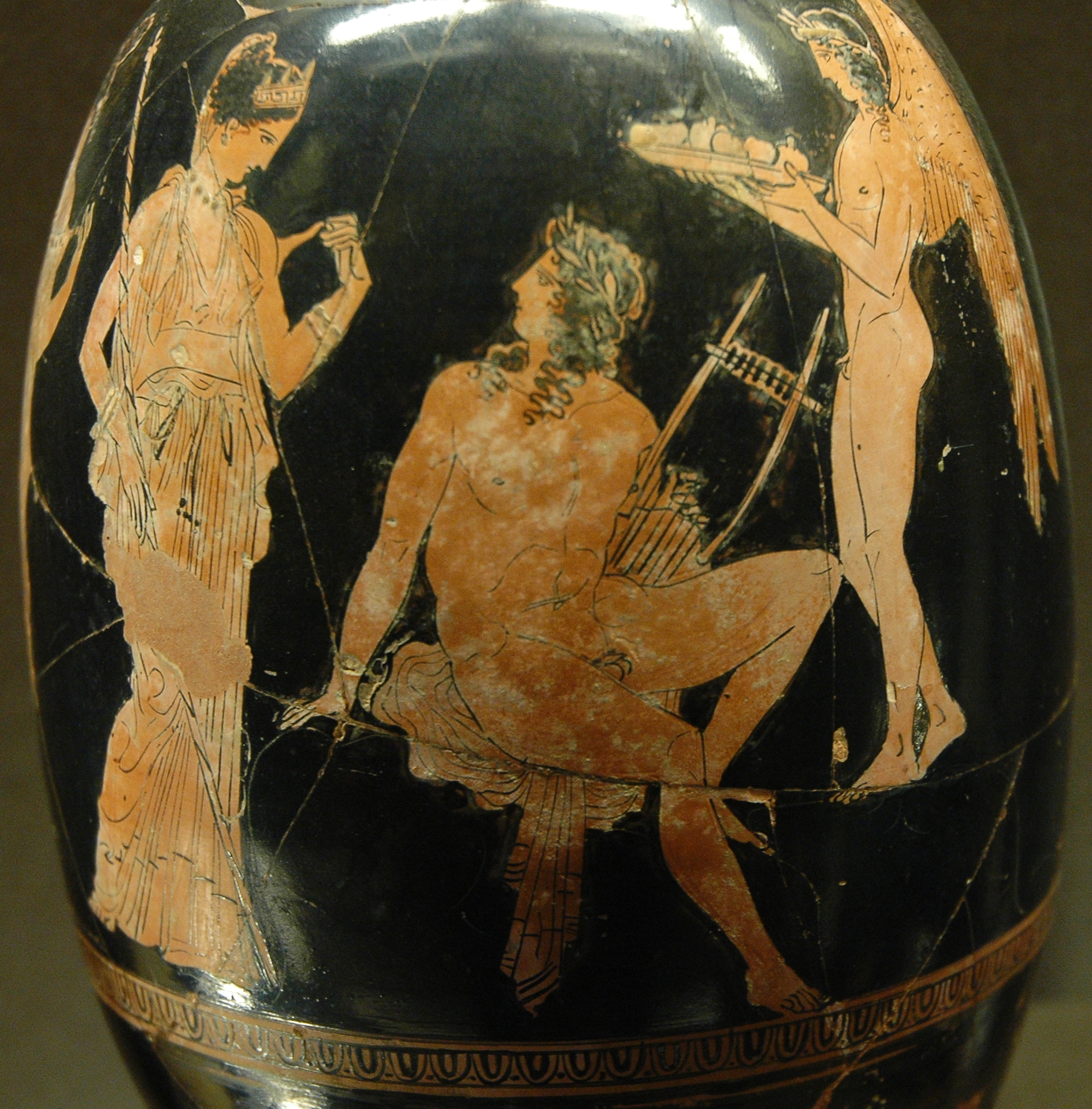
(Image source, http://upload.wikimedia.org/wikipedia/commons/f/f6/Aphrodite_Adonis_Louvre_MNB2109.jpg)
The crescendo of praise for Naaman that builds throughout the first verse crashes abruptly with a single word at the very end of the sentence: we are startled to learn that this foreign beauty is afflicted with leprosy, a terrible, disabling, disfiguring skin disease. This dream of a man, for whom the world is his oyster, who is an army commander, a V.I.P., always welcome in the corridors of power, a winner, a great warrior and a man of great strength, has been struck with the disease of those who are poor, malnourished, vulnerable and weak.
The irony of this story continues unabated as an offer of help comes to the great man Naaman in the form of a small, captive, nameless servant girl from a defeated country. In another reversal of great and small, the captive servant girl's own words are quoted verbatim in the court of the king. Then, when golden boy Naaman departs to obtain his healing, we come to the heart of things. Naaman expects to purchase his salvation from the prophet in Samaria with a boatload of stuff: ten talents of silver, six thousand shekels of gold, and ten suits of clothes. These "things" are are the tools for Naaman's "advance team."
The irony intensifies as Naaman approaches the king of Israel with a letter (another thing that "prepares the way" for Naaman) demanding healing. How is Naaman (or his boss, the Syrian king) to know that the king of Israel and the prophet in Samaria (and the prophet's God, YHWH) do not get along well and are usually on opposite sides of Israel's wars of religion? The king responds to the letter immediately by tearing his clothes (a visible sign of distress) and tells the truth (at least rhetorically): Am I a God? Am I able to kill and bring back to life? I cannot save this man from leprosy! But the king in Samaria also assumes that the Syrian king has an ulterior motive in making such an unreasonable demand, to pick a fight, to create an excuse to invade this vassal kingdom again.
Elisha, who just last week took on the mantel of Elijah, saves the day. Elisha invites the king to send Naaman to the prophet's own house. So, Naaman and his stuff arrive, expecting hospitality befitting his V.I.P. status. But Elisha doesn't invite him to come inside. Instead he sends out a messenger (mal'ak, an angel, like the little servant girl from whom Naaman has already received help) with instructions to go and wash seven times in the river Jordan. Because the prophet himself did not come out (notice the parallel with Jesus' sending of the seventy in Luke 10), Naaman is angry. His expectations regarding the mode for his salvation have been disappointed. He is not being treated with the deference and respect he demands. In a huff of superiority, he declares that the waters of his own land are better than those of Israel. He sulks away in a smoldering rage.
In another reversal of big and little things, it is once again the servants who save the day, reminding their master that he would have gone to any (great) length to secure his health, so why not do this (little) thing? The reading ends with Naaman's obedience and healing. Like Adonis, he is reborn. His skin is new like a baby's.

(Image source, http://thedailychapter.wordpress.com/2010/03/28/)
Our reading for today ends without telling us what happened to all the "stuff" that Naaman brought to purchase his salvation. For that, we must read the rest of the chapter. Note especially 2 Kings 5:19 and the connection to Luke 10:5.
Luke 10:1–11, 16–20

© Copyright 2010 by Debbie Rockey. Disciple Feet, Luke 10:11. Image rights available ($2.50) for church use.
Once again, Jesus sends out disciples (see 9:2) to preach the Kingdom of God and to heal those who are sick, like Naaman. The difference is that whereas Naaman sought out the prophet (and people often sought out Jesus), these disciples seek out the sick. Going from town to town, they have the job of getting folks ready for the coming of Jesus. They are the advance team, testing the receptivity of the town and the hospitality of its people and providing a foretaste of the Kingdom that is coming near.

© Copyright 2010 by Debbie Rockey. July 4 To Do List, Luke 10:4. Image rights available ($2.50) for church use.
Making preparations for an "event" can sometimes be as intense as hosting the party itself. It is in the making of arrangements that money is committed, relationships are formed, and the work of the advance team makes or breaks an event. Some venues and cities are better hosts than others, but even the best will not live up to full potential without good advance work.
The disciples could be excused for thinking that they needed "stuff" to roll out the red carpet for Jesus and the Kingdom. Like the Indianapolis Host Committee for Super Bowl 2012, they may feel the pressure to perform well.

(Image source, http://www.insideindianabusiness.com/images/news/logos/SuperBowlBidlogo.jpg)
And for that, they need "stuff," right? They need improved facilities, money, clothes, shoes, etc. They need to make a great impression, to polish their image, to "sell" the Kingdom event to those influential people whose acceptance or rejection of their message means so much.
But Jesus is having none of it. Like Elisha, he is refusing the "stuff" and reinforcing the message that the Kingdom of God comes to town on the dirty, dusty feet of little servant girls and poor disciple messengers. These are feet without shoes, people without money, without extra changes of clothes. They bring one thing only, the message of peace. As they heal the sick, they say that the Kingdom of God has come near. They eat what they are given and go where they are told, stay where they are welcomed and move on when they are not.
Discipleship does not require a lot of packing. Are you ready? Leave your stuff. Forget your list. The harvest is plentiful, but the laborers are few. Have your feet been reborn? Are they in the picture? Is your name written in heaven? Then rejoice!

© Copyright 2010 by Debbie Rockey. Disciple Feet, Luke 10:2. Image rights available ($2.50) for church use.




 Posts
Posts