, Liturgical Press) Who knew that hospitality is such a yard stick (measuring cup) for forgiveness?
But before we turn to the Gospel of Luke, we pause for a moment to consider the Psalmist's cry of desperation.
Psalm 5:1-8
The Psalmist begins with a prayer for attention, which moves from a plea for God to take the earplugs out and turn to face the supplicant ("give ear") to a plea for God to take enough interest in what is being said that the prayer will register on the divine radar. The psalmist wants God to listen with understanding and discernment, to distinguish (binah) the individual words, phrases, and sentences so that sounds of the supplicant's prayer will be intelligible to God. The psalmist wants God to understand the prayer, not merely to hear the sound of praying.The psalmist's prayer is characterized as a cry for help by someone who has been hurt. (shewa`; the root occurs 11 times in the book of Job and 10 times in the Psalms, but only rarely elsewhere.) Such cries of distress have a purpose and that purpose is to summon a strong helper, a hero. In this case the hero is God, who is envisioned in his role as king. (A warrior and defender; someone with great power; if the king cannot help, who will be able?)
Scroll to 3:11 for the relevant section.
Even though I'm president of the United States, my power is not limitless, so I can't dive down there and plug the hole. I can't suck it up with a straw. All I can do is make sure that I put honest, hard-working smart people in place ... to implement this thing.(President Barack Obama)
What sorts of things, other than oil spills, merit such a cry? The need for mercy (from a judge; Psalm 28), the need for healing (Psalm 30), and the need to be found or located (e.g., when lost at sea; Psalm 31), among others.

(Image source, http://nbcsports.msnbc.com/id/37650809/ns/sports-othersports/)
Photo: 16-year-old, Abby Sunderland, in her wrecked sailboat, Wild Eyes. She is now on a French fishing vessel, which rescued her half way between Australia and the coast of Africa. She spent two days without communication and sent out distress signals before she was rescued.
The Psalmist ends on the same theme we will see soon in the gospel reading, the one who has been saved from much also loves much. Gratitude is the hallmark of the life saved.
Luke 7:36-8:3
It helps first to remember the Roman setting of Jesus' party invitation. Often we make unfounded assumptions that can be dispelled with a few images, imaginative reconstructions of the Roman triclinium, the arrangements of the three couches, the placement of the table, the open end from which food would have been served.

(Image source, http://library.thinkquest.org/22866/Dutch/Plaatjes/aanlig2.gif)

(Image source, http://www.forumromanum.org/life/johnston180.jpg)

(Image source, http://www.forumromanum.org/life/johnston179.jpg)
306. The places on each couch were named in the same way, (locus) summus, medius, and īmus, denoted respectively by the figures 1, 2, and 3 in Figure 179. The person who occupied the place numbered 1 was said to be above (super, suprā) the person to his right, while the person occupying the middle place (2) was above the person on his right and below (īnfrā) the one on his left. The place of honor on the lectus summus was that numbered 1, and the corresponding place (1) on the lectus īmus was taken by the host. To the most distinguished guest, however, was given the place on the lectus medius marked 3; this place was called by the special name locus cōnsulāris, because if a consul was present, it was always assigned to him. It was next to the place of the host, and, besides, was especially convenient for a public official; if he found it necessary to receive or send a message during the dinner, he could communicate with the messenger without so much as turning on his elbow.(Johnson's Private Life of the Romans)
Roman dinners were social events, with guests. We too often forget in this age of home theaters that home entertainment in the Roman world was of necessity live entertainment. There was music and dancing. ("`We played the flute for you, and you did not dance; we sang a dirge, and you did not cry.'" Luke 7:32, NIB) There was recitation of written work, poetry and speeches, plays and the "good" parts of the best tragedies and comedies. And there was Jesus. He could be counted on for a miracle, a sign or good work, an exorcism, a good parable, a provocative statement, or something else altogether unexpected. You have to wonder from all the dinner invitations he received whether Jesus was considered by some of the rich folks of his day as just another form of entertainment. ("The Son of Man has come eating and drinking, and you say, 'Look, a glutton and a drunkard, a friend of tax collectors and sinners!'" Luke 7:34, NRSV) For a good description, see the Wikipedia article on Roman cuisine, table culture
So, Jesus received yet another invitation to dinner, this time from a Pharisee. He accepted, Luke says, taking his place (which one?) and reclining with the other guests at the table. (Luke 7:36) About that time a woman who has heard that Jesus will be reclining on that couch at dinner in the Pharisee's house shows up with an alabaster bottle of ointment or perfume (muron) she has bought for the occasion. It is strongly aromatic, often used for anointing dead bodies (Luke 23:56).
The Expensive Stuff
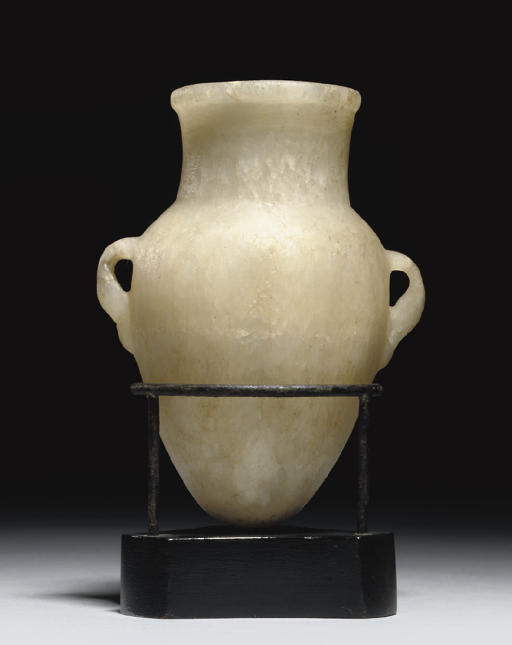
(Image source, http://www.christies.com/lotfinderimages/d49742/d4974297x.jpg)
The Cheap Stuff

(Image source, http://www.jerusalem-antiquities.com/images/Roman%20Glass%20Perfume%20Jar6.jpg)
The woman with her alabaster jar walked into the room in full view of the guests and made her way around the table until she stood behind Jesus. There she took her stand, weeping, and began to shower his feet, drenching them with her tears. She was wiping them dry with her hair. And she was kissing his feet and anointing them with the perfume.
The host, taking it all in, says to himself, "He's no prophet! Or he would know what sort of woman is touching him (7:39, hapto, most often of people "grabbing" Jesus, hoping he will "touch" and heal them: e.g., Luke 5:13; 6:19; 7:14; 8:16, 44-47; 11:33; 15:8; 18:15; and 22:51). This is nothing new or out of the ordinary to Jesus. People in need are always grabbing for him. Parents are always bringing their babies to him so that he may touch them. But this woman's a sinner! (harmotolos, see 5:30, 32) Jesus was always being accused of fraternizing with sinners and publicans by the Pharisees; yet, whose table is he sharing today?
Jesus turns to his host and says, "Simon, I have something to say to you." Now we get to glimpse the guise under which Jesus has been invited, because Simon responds, "Go ahead, teacher!" (didaskalos)
Jesus offers an after-dinner parable:

(Image source, http://newportricheyflforeclosures.com/images/forecloserichie.jpg)

(Image source, http://housesforeclosure.net/wp-content/uploads/2009/09/bungalow.jpg)
A man who owed (chreopheiletai $500,000 and a man who owed $50,000 both had their loans re-negotiated with the bank (see Luke 16:5). (charizomai, generously, graciously, forgave and pardoned.) Now neither man owes anything, both have unblemished credit scores, and both can keep their houses. Tell me, which will love the banker more?
Jesus replies, "You judge correctly." (Similar to the way the Psalmist prays that God will hear and understand his prayer.) Then Jesus convicts Simon: "Do you see this woman? I entered your house; you gave (didomi, echoing the inability of the debtors to "repay," apodidomi, their obligation) me no water for my feet, but she has bathed my feet with her tears and dried them with her hair." (NRSV, Luke 7:44) Jesus continues enumerating the host's many obligations, a kiss and oil for his head, which Simon had failed to perform. Her many sins have been forgiven, for she loves much. ...and then he trails off, ...but the one who has been forgiven little loves little.
Perhaps the most astonishing thing about the story is the order in which the statements occur. Jesus makes the declarative (objectively real) statement to Simon that the woman's sins have been (perfect! / past) forgiven before he turns to the woman and informs her (subjectively real) that her sins are (now) forgiven (perfect!).

(Image source, http://test.huntmuseum.com/qzty2o/2276.jpg)

(Image source, http://www.carlos.emory.edu/files/05classic05L.jpg)
The other guests are flabbergasted, asking, as will often be the case with Jesus, "who is this who even forgives sins?" Jesus, not missing a beat, says to the woman that it is her faith that has saved her. Her love for Jesus is an expression of the depth of that faith. Her love is deeper, it seems, than the love of Simon, and so is her faith.
How deep is my love?

How much faith do I have?



 Posts
Posts