Showing posts with label Year B. Show all posts

Saturday, November 21, 2009

His Kingdom Is Us?

2 Samuel 23:1-7


It seems somehow fitting that we end the Christian year with the "last words" (dibrey ... ha'acharoniym) of David. If we begin the reading just a verse earlier (2 Samuel 22:51), we also clearly pick up the theme of Christ (meshiycho) the King (malko). God is a tower of salvation for his "king," one who shows steadfast mercy (chesed, loving kindness, covenant loyalty) to his "anointed one." This statement of fact is born out by what follows. David is Israel's quintessential messiah, or anointed king. Now, at the end of his life, the question is whether his last words will bear witness to the truth of the statement about God's faithfulness in 22:51.
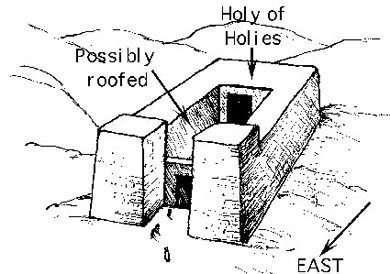


(Image Source, http://www.astarte.com.au/assets/images/sketch.jpg)
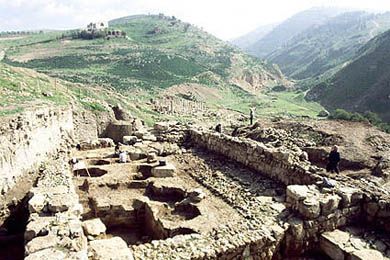


(Image Source, http://www.astarte.com.au/assets/images/Temple2003.JPG)

The LBA "migdol temple" at Pella provides a glimpse of the concrete "tower" of protection provided by the LORD to his anointed, David. (See 1 Samuel 21:1-8, etc.)


David's "last words" are uttered more as a prophet's oracle (ne'um, or like the Wisdom speeches in the Book of Job) than as a king's command. And it is clear that the power of these words is derivative. David is simply "Jesse's son," who has been raised up, anointed, and loved by Israel's God. The words David speaks are not originally his; they are breathed by the LORD (ruach YHWH) and placed like food on David's tongue. David is merely the chosen and anointed messenger, a singer of divine songs, if you will.


(Image Source, http://iamyouasheisme.files.wordpress.com/2008/11/eat_the_book.jpg)

The Spirit of the LORD who speaks through David's lips here (23:2) is not a stranger to the leaders of Israel. The Spirit came upon Othniel and Jephthah, on Sampson and even upon Saul, who was David's predecessor. But none of them was so thoroughly marked by the Spirit for kingship as David. David was Israel's king and anointed one par excellence.
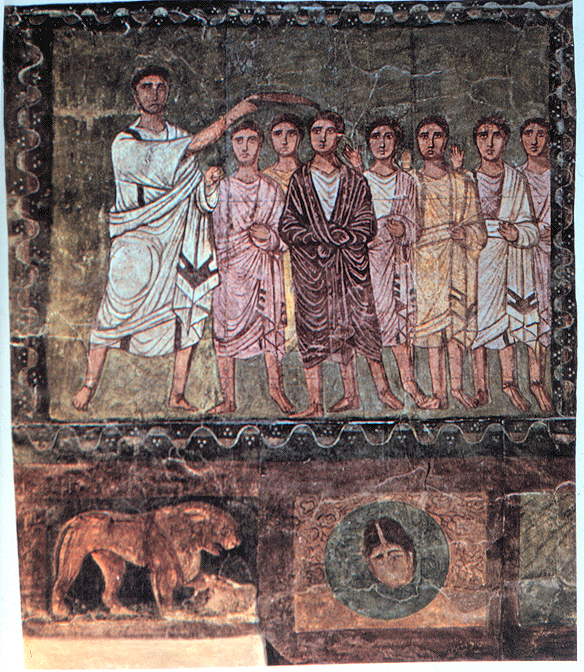


(Dura Europos, Syria. Source: Gill/Gillerman slide collection. Image Source, http://upload.wikimedia.org/wikipedia/commons/d/d4/Samuel_e_david.jpg)

1 Samuel 16:13, "Then Samuel took the horn of oil, and anointed him in the presence of his brothers; and the spirit of the LORD came mightily upon David from that day forward. Samuel then set out and went to Ramah." (NRSV)


Even for kings there is a higher authority to whom they are accountable. There is a right way and a wrong way to rule. Those who rule in accord with universal human rights (ba'adam tsaddiyq) and with reverence toward God (yir'at 'elohiym) are gladly received because of the blessing they bring to their subjects. (23:3)


(Image Source, http://cache.virtualtourist.com/2318769-Morning_light-Walpole.jpg)

Such kings are like the morning light; their advancing presence clears away fear and darkness. Their presence means a day without clouds overhead, a day in which the morning mist glistens on the grass as a brilliantly sparkling display of God's blessing. The morning light allows the dew to linger a while. A morning sun warms but does not scorch. It is a welcome ray that drives away the chill of night. (23:4)


David asks, rhetorically, "Is my house [= my royal family; see II Samuel 7:11-12] not thus with God?" The answer he seeks is "Yes! Of course it is! Long live King David!" And David lines up evidence to support his claim of royal benevolence:

  • God has made an everlasting covenant (beriyt `olam, II Samuel 7) with David and with his descendants. (Would God do that, if David had not been a good king?)
  • God has kept things orderly and rule-y while David has been on the throne. (Despite attempts, there has not been a coup d'état. David has reigned a good long time.)
  • God has (or will) prosper David's help (salvation) and desire (wants).

(23:5)


A worthless [king], on the other hand, is as welcome as a thorn. (Judges 9:7-15)


(Image Source, http://www.hubbo.com/images/2002-05-22/thorny-shrub-close.jpg)

No one wants to get close. No one wants to keep them. (Or their children who come to the throne after them.) Everyone throws them away, because they cannot be held in the hand without getting hurt. (23:6)


(Image Source, https://blogger.googleusercontent.com/img/b/R29vZ2xl/AVvXsEg0_xxCqcgkiGGyQ7v_w2Revxo1NqETKBle-hZ9ox8OKA8O4T6SaZbhe_c0YPuL5_A0QknyALwUQJuO29Y4Oiq5o6MgcSH7XOAwEpBLkzVxT60lOaU0ABezidCpniDDufa3ReS100Jj2ptI/s1600/thorns.jpg and http://www.rosegardeninghelper.com/wp-content/uploads/2009/09/3104TSX418L._SS400_.jpg)

To touch them at all, one uses metal tools, military tools, that can be manipulated from a distance. (23:7)


(Image Source, http://i.ehow.com/images/GlobalPhoto/Articles/4592155/Prunerosebush_Full.jpg)

They are then burnt "on the spot" (bashebet, where they sit: i.e., on the throne).


(Image Source, http://oaksavannas.org/photos/brambles-burning-013.jpg)


David is surely the former rather than the latter sort of king. David has lived, after all, to give his "last words." He has not been deposed and there is every reason to think that his heir will sit on the throne of Israel. The only question is which heir and whether the heir will follow in David's path as a good king or become thorny. But perhaps David's last words protest too much. There were times when David's actions--and those of his heirs--had brought calamity on his subjects. (With Uriah and Bathsheba, for example, 2 Samuel 11 and 12.)


(Image Source, http://restorationupdates.com/advice-tips-and-hints-to-be-restored/repentance-is-absolutely-important/)

But overall the judgment of Scripture is that David was a good king, a good example for future kings, for "rulers" of all sorts (e.g., elders and pastors in churches), and a prophetic glance at what comes next.


Revelation 1:4b-8


The revelation of Jesus Christ makes as clear as can be, as clear as flesh-and-blood, who is the authority behind all earthly authorities, the king of all kings, the "ruler of the kings of the earth." There is a right way and a wrong way to rule. His is the right way. His rule produces for his subjects:

  • Grace
  • Peace
  • Life (from the dead)
  • Faithfulness (the equivalent of chesed, covenant loyalty)
  • Love
  • Freedom

We expect this of a good king, the very best king. We expect that his reign will be long. An eternal covenant or politic can only be maintained by a king (or royal family) who is and was and will be the beginning and the end, the alpha and the omega. What may come as a bigger surprise to us is that we all are his subjects. We are his kingdom. (1:6) We, like David, are his "last words" to the world, priests (more so now than prophets).
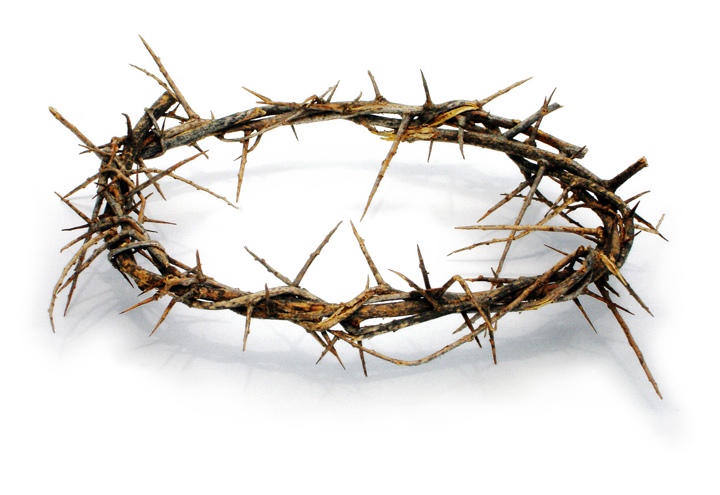


(Image Source, http://frmarkdwhite.files.wordpress.com/2009/02/crown.jpg)

The question is whether we, Christ's heirs (or co-heirs with Christ), will embrace our crown (3:11) and our calling, bringing grace, peace, life, faithfulness, love, and freedom to our world, so that he may be welcomed by all.


John 18:33-37


This scene hardly needs an introduction. Jesus stands in Pilate's headquarters, in front of Pilate's judgment seat (throne), a good ruler under arrest by tyrants. Pilate, an earthly "king," claims to stand outside Jesus' jurisdiction. ("I am not a Jew, am I?")


(Image Source, http://www.cts.edu/ImageLibrary/Images/story/pilate.jpg)

Pilate claims that Jesus' own subjects (your nation and your chief priests) have handed Jesus over to him. The implication seems to be that Jesus is a bad king, if he is indeed a king at all. But Jesus objects that his kingdom is not of this world, not from here. The venue for Jesus' trial--and vindication--is elsewhere. That where seems to be a place where kings embrace thorny subjects and undergo severe punishment so that those they rule may go free. Pilate, perhaps thinking that he has trapped Jesus, says "So you are a king?" Jesus does not answer directly. (Nothing new about that!) But he appeals to the primary attribute and calling of a good king, the ability to judge his subjects on objective (Truth) grounds. A good judge is just ('adam tsaddiyq) and has a great reverence toward (fears) God. Unlike David, whose jurisdiction is limited to Israel, Jesus' reign extends to all who recognize the truth of his "last words."

Saturday, November 14, 2009

Fighting Over Jesus

1 Samuel 1:4-20


Mark 13:1-8


This passage immediately follows the scene of the widow with her two coppers. (Last week's reading, Mark 12:28-34.) For a while now Jesus has been teaching in the temple, saying some provocative things. In Mark 11 he makes his not-too-subtle entry into Jerusalem, borrowing a colt for his purpose with hardly a "by your leave." ("The Lord needs it...," 11:3.) He curses the fig tree. ("May no one ever eat fruit from you again," 11:14.)


(Image source, http://upload.wikimedia.org/wikipedia/en/3/33/Miracleofthefig.jpg)


(Image source, http://www.dkimages.com/discover/previews/795/396066.JPG)

He drives out those who are buying and selling in the temple, overturning the tables of the money changers, not allowing anyone to carry anything through the temple, 11:15-16. When he does finally start teaching, Jesus accuses those to whom he is speaking of turning what should be a house of prayer for all nations (gentiles and Jews) into a den of robbers.


(Image source, http://upload.wikimedia.org/wikipedia/commons/0/0f/Wypedzenie.jpg)


Jesus so angers the leadership with his words and deeds that they want to kill him. Perhaps Jesus is tailoring his message to the crowds (11:18), to provoke their leaders, but the message in private to his disciples is equally provocative (to Peter [11:21ff.], "believe!" and "forgive!"; in private [13:3], some will claim "I am he!"]). Jesus is blatantly confrontational, even combative, seeking to "divide and conquer" the leaders who come to question the authority for his words and actions. His question is designed to produce a civil war. Riddle me this: "Was John's baptism of human origin or was it from God?" And the question produces its desired effect. (11:27-33)


Jesus attacks the leaders obliquely, obscuring his meaning momentarily with parables, but they understand all too well that he is "telling the parable against them." (Mark 12:12) Again they want to arrest him, but put it off. They send instead some smart folks to try to trap him using his own methods, asking him a divisive question: "Is it lawful to pay taxes to the emperor or not? Should we pay them or should we not?"


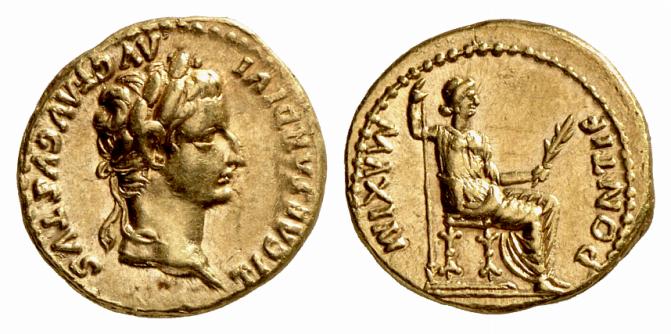
(Image Source, http://www.romancoins.info/h2005-mint-tiberius2.jpg)

Jesus' answer to their question, based on an inspection of a denarius, punts the ball back to them: "Give to Caesar what belongs to him and to God what belongs to God." After so deftly handling this dispute between the Pharisees and the Herodians, in which he leaves them bickering still about whether to pay taxes, Jesus is asked another litmus-test question by some Sadducees: which of seven brothers will have the barren wife on the day of resurrection? This time Jesus tells his questioners bluntly, not once but twice, that they are quite wrong--and ignorant of the Scriptures. (Mark 12:24, 27)


Another person, a professional, overhearing this dispute between Jesus and the Sadducees, brings to him yet another divisive question: "Which is the greatest commandment?" It so happens that this person agrees with Jesus' answer completely, verbatim. Yes, yes, Jesus, you are so right! And so what does Jesus say? Does he congratulate the man? No. Jesus says, "almost there! You are very near the Kingdom, not very far at all to go now." In other words, "close, but no cigar!" (Mark 12:34) That shut them all up.


Now Jesus, in the temple, turns his attention to the widow woman with two coppers making her way toward the offering plate. (See last week's Bible blog entry.) You might ask how Jesus could ever possibly make a controversial statement about a widow's offering, yet he does: "She has given more than all the rest," he says. (Mark 12:43)


Thankfully, time has now come to leave the temple, before Jesus can stir up even more animosity and trouble. That's where our reading today began.


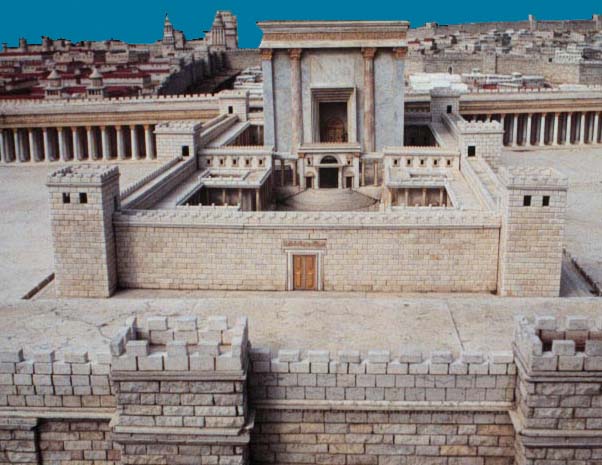
(Image Source, http://jameswwatts.net/REL%20302%20notes/2TempleModel1.jpg)

On their way out, the disciples remark on the edifice and the stones that went into it; and Jesus, unable to let their comment pass, says "Not one of these stones will be left standing on top of another. All of them will be thrown down flat on the ground." (13:2)


(Image Source, http://adamhamilton.cor.org/wp-content/uploads/2009/03/temple-ruins1.jpg)

Their shock at Jesus' words is evident in the way Peter, James, John, and Andrew huddle with Jesus, expressing their concern. Tell us when; what will be the sign that the things you have said are about to happen? But instead of telling them when it will happen, Jesus gives them a list of signs that the end has not yet happened. (Mark 13:7, 8) There are miles to go before we sleep. Jesus seems to be saying that until the end comes, conflict will be ubiquitous. Wherever we look in our relationships--between nations, between families (and within families!), with nature, in church (wherever!) there will be disagreement, conflict, strife, natural disasters, suffering, pain, and loss. These things will be with us, unavoidably, until the very end. If Jesus, the Son of Man, the Messiah, did not escape it or avoid it but endured it, persevered and even embraced it--where does that leave us, his disciples? If Jesus is headed toward the cross, perhaps his increasing assertiveness in these last few chapters of Mark in the face of those who oppose him is a model for how we are to live in these contentious times. Where and how are we called to account? Asked divisive questions. Pursued with malice because of the way we answer? And especially, where are these things true not just because that's the way life is, but because we follow a troublemaker who isn't willing to let the status quo ante (i.e., death) prevail?

Saturday, September 5, 2009

Rich Man, Poor Man

Generosity and Justice, Grace and Righteousness


Proverbs 22:1-2, 8-9, 22-23


22:1-16 is composed of a series of comparisons, specifically contrasts between the path (or life) of a wise person vs. a fool. The compiler of this collection of aphorisms uses antonyms for good and stark effect. There are no shades of gray here, no blurred lines. All is either black or white.


22:1, Contrast, Riches and Reputation


The first contrast is between a tangible good and one that is intangible. Riches are good, but there is something better. The wise person makes the better choice: a [good] name (fame, reputation) and good favor (popularity). The fool sells himself short and settles for money over good personal relationships and the high regard of others. The proverb doesn't give us specific examples, but examples of wise (or blessed) folk in scripture who gained favor with God and with others are: Noah (Genesis 6:8, etc.), Ruth (2:2, 10), and Esther (2:17, 5:8, 7:3). See 1 Samuel 1:18; see also Genesis 11:4 and 12:2 for a cautionary note about establishing one's own reputation vs. a strong faith in God's fulfillment of his promise to establish us.


22:2, Comparison, Rich and Poor


What do a wise person (rich) and a fool (poor) share in common? A single "maker." This proverb includes but goes well beyond the act of initial creation. It avers that the LORD remains in the director's chair, willing and doing his good pleasure. Hence the wise person and the fool will often (always?) have different ends, despite similar beginnings. The wise person embraces and follows God's "doing and making," whereas the fool rebels and tries to reject God's work. The wise becomes rich, the fool is impoverished.


22:3, Contrast, Open and Shut


Caution, road out ahead. (Image Source, http://farm1.static.flickr.com/24/90451693_084e5fd5d1.jpg)

The alliteration (both assonance and consonance) employed in the first three words of this verse is a mark of the literary craft to be found in the whole collection. Note the opening line: `arûm ra´â ra`â, "the wise person sees evil [things]" coming and hides. The word for "a wise person" (`arûm) here is the same word used in Genesis 2:25 (the man and his wife were both "naked" [`árûmmîm] and were not ashamed) and in Genesis 3:1 (the serpent was more "subtil" [`arûm] than any beast of the field). The motif of secret things and secret places, things hidden, is very much in evidence here. The wise can see through obscure things and into dark places; they have advance warning systems and sophisticated radar to detect danger. They proceed with caution. The fool on the other hand is oblivious to even the most obvious warning signs. The big detour that warns of a bridge out ahead is ignored as the fool guns the engine and plunges headlong into a watery grave.


22:4-5, Contrast, Carrot and Stick


The first verse lays out the carrot, the reward, for a life of humility and a genuine fear of (respect for, worship of) the LORD. However, this isn't a case of external manipulation; it isn't a matter of trying to get someone to do something he or she doesn't already want to do. Rather (like the "seed" example to follow in verse 8), this "reward" is actually a built-in consequence; it is the result, or the natural end place, for someone who lives in humility and the fear of the LORD. Such people will naturally wind up with riches, glory, and [long, good] life.


This image shows just how hard it can be to detect a snare. This is very definitely the wrong road to be traveling. (Image Source, http://tumaren.wildlifedirect.org/files/2009/01/snare1.jpg)

On the other hand, sharp, spiny thorns and bird-trap nets seem to sprout up overnight everywhere along the road of the "crook" (crooked, twisted, perverse, perverted, or "froward" [gotta love the King James Version]). Again, this is not an external imposition, a punishment of some sort meted out directly by God. It is safe to say that the "God-fearer" and the "pervert" aren't traveling the same road. If they were, the conditions of the road would be the same. If both were traveling the road of humility, the result would be riches, glory, and life. If both were traveling the crooked path, both would encounter thorns and snares. If you want to keep your life, you'll stay away from the crooked road strewn with thorns and bedeviled by snares.


A net snare for small birds (Maori). (Image Source, http://www.nzetc.org/etexts/Bes02Maor/Bes02Maor482a.jpg)


22:6, Comparison, Young and Old


(Image Source, http://www.baltimoresun.com/media/photo/2008-05/38979882.jpg)

This is perhaps the most famous verse in all of Proverbs, yet nearly every translation obscures the most common meaning of the first word, chanok. In the few other biblical instances of its use, the word means to "dedicate" something (usually a house, or public building) to a particular use (usually holy). It can mean to inaugurate or "baptize" (break-in, initiate). In other words, the point is to put a young person on the right road, at the right starting line, aimed in the right direction...and when he or she finally comes to the end of that road, all will still be well. Dedicate a young person to the right path at the start and the wrong path will not be a problem at the end. Don't put a horse in the starting gate at the Preakness if you are wanting it to cross the finish line in the Kentucky Derby. Some things are by definition impossible. Take care of the starting gate (which is all a parent or teacher can really effect) and the finish line will take care of itself (or, in more theologically straightforward language, God will take care of the finish line).


(Image Source, http://fineartamerica.com/images-medium/finish-line-michael-lee.jpg)

Isaiah 35:4-7a


Psalm 125


Psalm 146


James 2:1-10, (11-13), 14-17


Mark 7:24-37

Saturday, August 29, 2009

"Tradition, Tradition!"

There are things that we receive in life from others, things handed down to us from parents, teachers, and other cultural influences. Sometimes we cling to these "traditions" for the good; sometimes not. Do we have "traditions" that we will not let go in order that we may reject evil thoughts, immorality, theft, and the like? What "traditions" have we already let go of that we should be clinging to with all of our strength? (And is love a better motive for hanging on to something than obedience? Or are they so closely related and coordinated as to be indistinguishable?)


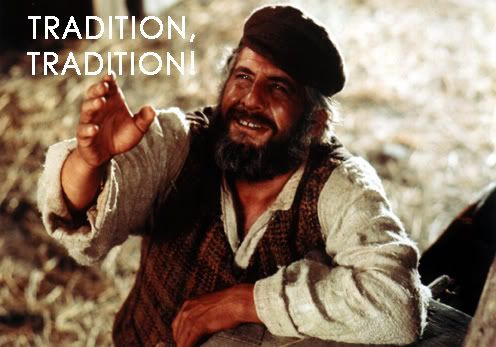
(The title for this entry obviously has it's origin in the classic film, "Fiddler on the Roof." Image Source, http://i64.photobucket.com/albums/h199/jandkatlarge/Tevye.jpg)

Deuteronomy 4:1-2, 6-9


The Book of Deuteronomy is, according to its Hebrew title, a book of "words," a collection of the Words of Moses, which he spoke to "all Israel" on the far side of the Jordan River before the people of God crossed over to take possession of the Promised Land. (Deuteronomy 1:1, 21, etc.) Deuteronomy 4, therefore, appropriately begins with a command to "listen up!" (šema`, not at all unlike the more famous "Shema" in Deuteronomy 6:4.) This call for attention is one replayed many times in many cultural contexts both today and in yesteryear: in court, when the judge enters the room to take a seat; in the assembly hall, when a speaker rises to begin prepared remarks; in the classroom, when a teacher is ready to begin a lesson; in the sanctuary, when it is time for worship and for the reading of the Word of God; in the home, when a parent addresses a child about a matter of importance.


According to Deuteronomy, Moses played all these roles for the people of Israel. He was in some sense a prophet or preacher, helping Israel hear and obey God's word. He was in another way, Israel's premier law-giver (president, senator, judge; handing out chuqqîm and mišpatîm, 4:1). He was also Israel's teacher (lamad), instructing not just in "book learning" but in practical "how to," hands on demonstrations of what to do and how to act (`asah). The words that Moses speaks here are, like all the words of Deuteronomy, performative. They make a difference in the lives of the hearers. In fact, like the words spoken by God on the first day of creation, they give life to those who hear and obey them. Those who hear and obey these words will live and will successfully enter and take possession of the future that God has prepared for them. Life is a divine gift--a gift from the "God of your fathers"--that is "passed on" (handed down, "tradition-ed") to the children of Israel by these words of Moses.


This word of promise comes also with a word of warning, a command of "thou shalt not." According to Moses, the words recorded here are complete. They do not need any mathematical computation--neither addition nor subtraction--to get them to work out right. They work fine just as they are presented; they'll be ruined by increase or decrease. Thou shalt not add to or subtract from them on pain of forfeiting life itself. (Deuteronomy 4:2; see Revelation 22:18-19.) In this way, the instructions of this chapter (and the book as a whole) are very much like the "10 Words" or "10 Things" (Exodus 20 and Deuteronomy 5), the "10 Commandments." The list of God's commands (tsavah,mitsvoth) is complete and succinct. It needs only to do them to live.


But, of course, Israel didn't always do what God had commanded. Idolatry was the first and most frequent of the commandments broken, and it was clearly also the chief offense, the number one law broken, a capital offense. The verses skipped by the lectionary here (Deuteronomy 4:3-5) concern one such incident, when some of the people of Israel allied themselves with the people of Moab and (either for reasons of personal devotion, or, what is more likely, for reasons of marriage, tribal, and political alliance) began to "bow down" to Baal-Peor and to eat (ritually) sacrifices offered to Baal. (See Numbers 25, Psalm 106:28, and Hosea 9:10.) Moses appeals to Israel's memory of this experience to prove the point that obedience to God's commands brings life, while disobedience means certain (and widespread) death. There is some irony here that should not escape us. While the passages that mention the incident of Baal-Peor seem to lay the blame at intermarriage with the people of Moab, we would do well to remember this complicating fact: Ruth (the great-grandmother of King David) was...gasp...herself a woman of Moab. (Ruth 1:4, 4:15-22, etc.) And in the Christian tradition, King David was the "father" (several generations removed) of Jesus. (Matthew 1:5)


When our reading resumes in Deuteronomy 4:6, Moses is giving yet another reason for obeying these words of his. He says that these words represent "wisdom" (chokmah) and "discernment" (binah)--something that is sought by all nations, large and small. If the people of Israel will heed his words, they will become famous, and perhaps envied, throughout the world, especially among the foreign nations that surround them (like little Moab their neighbor, just mentioned, or the major players: Egypt, Babylon, and Assyria). Wisdom and understanding represent the educational "traditions" of the international community of Israel's day. It is no mistake, for example, that Solomon--maker of broad international alliances--is regarded as the founder of Israel's wisdom tradition. Solomon's name is associated with Proverbs and Ecclesiastes (or Qohelet, another "preacher") as Israel's consummate teacher. But in our passage such wisdom is distilled in the words of Moses.


Deuteronomy 4:7 speaks of God's nearness to Israel. Given the emphasis of Deuteronomy on the "tradition" of God's word through Moses, perhaps we are to think here of the very proximate "give and take" of an intimate conversation. God is near enough to hear and answer when Israel calls. (But is Israel also near enough to hear and obey when God calls?) According to Deuteronomy 30:14, God's word is very near--lighting on our lips and penetrating to our hearts. (See Paul's quote of this verse in Romans 10:5-13; "everyone who calls on the name of the Lord shall be saved.") If we see these words of Moses as words of faith (which they must be, since Israel has not yet entered the Land of Promise), then we may think of ourselves as part of the very long line of this "faith tradition" of which Moses was already a "child" and recipient as well as a "parent" and promulgator: Hebrews 11:9, By faith he [Abraham] stayed for a time in the land he had been promised, as in a foreign land, living in tents, as did Isaac and Jacob, who were heirs with him of the same promise. (NRSV)


In Deuteronomy 4:8, Moses continues to make his case that Israel's role is to be an example to the nations, a point of comparison and contrast, especially in the area of "justice"--no nation has laws and statutes that are more righteous than Israel does. Finally, Moses says, guard yourself, guard your soul very closely, so that you do not forget what you have experienced or let the cherished memories fade with time as you grow older. Time has a way of erasing some of the sharp detail of what we have learned. Moses says that it takes a vigilance--a kind of constant study--not to lose these "words" that we have been given. In particular, it takes teaching them (making them known, yada`) to our children and grandchildren. Never is anything ever learned so well as by a teacher, who must master the subject in order to teach it well to someone else.


Mark 7:1-8, 14-15, 21-23


The Gospel reading opens with certain "pharisees" and "teachers of the law" (aka "scribes," grammateus), who have "come together" (synago) from Jerusalem to meet with Jesus. When they see Jesus' disciples eating bread (literally; or figuratively, any food) with "common," "unwashed" (ritually unclean) hands(koinos, aniptos), they ask Jesus why his disciples do not live according to the traditions (paradosis, "handing down") of the elders (presbyteros). By way of answer, Jesus quotes Isaiah, who says, "these people honor me with their lips (cheilos), but their hearts (kardia) are far from me." It would seem that Jesus is responding out of the notion of God's nearness, saying that the words (of the elders, or of Moses) have landed on the people's lips, but have not yet penetrated to the depths of their hearts. Moreover, in using the word "hypocrite" (hypokrites to describe the people to whom he is speaking, Jesus also emphasizes the difference between hearing and doing, knowing and obeying, between meaningless, empty words and active, useful, performative words. Mark 7:7 reiterates Jesus' point: "in vain (maten) they worship me, teaching human commandments as their teachings." Jesus then drives the point home: they lay aside (or let go of) God's words (the commandments), so that they may grab hold of (and hold on to) human traditions (Mark 7:8).

It seems that Jesus is making a strong distinction between God's commandments and human traditions. He is also making a sharp distinction between that which comes into contact with a person from the outside (unclean, or ritually common food) and that uncleanness which originates in a person's heart and makes its way out in human words and actions. (Mark 7:14-15) "For it is from within, from the human heart, that evil intentions come: fornication, theft, murder, adultery, avarice, wickedness, deceit, licentiousness, envy, slander, pride, folly." (Mark 7:21-22, NRSV) In other words, the contravention of God's words comes from a human heart that is far from God. Jesus does not directly contradict Moses here (in fact, he doesn't seem much to have Moses in view), he simply shifts the focus. Moses is insisting that the people Israel get the words of God onto human lips and into human hearts, so that they might live; Jesus is insisting that his disciples live the commandments as evidence that it is God's law in their hearts as well as on their lips. In both cases, it is what we do that counts in demonstrating our closeness to God and God's closeness to us.


In other parts of the New Testament, it is clear that this distinction between the "words of God" and "human traditions" is also operative. For example, Paul realizes that his words could have been categorized either way, rejected or accepted, but he gives thanks that when the Thessalonians "received the word of God that you heard from us, you accepted it not as a human word but as what it really is, God's word, which is also at work in you believers" (1 Thessalonians 2:13, NRSV). In speaking of the Lord's Supper, Paul says "For I received (parelabon) from the Lord what I also handed on (paradidomi) to you, that the Lord Jesus on the night when he was betrayed took a loaf of bread,..." (1 Corinthians 11:23, NRSV). The same can be said of the gospel itself, which is "tradition-ed" (handed on and received) in the form of human communication. Whether it is received is often contingent on whether it is perceived as the "Word of God" or merely "human traditions." Take the following examples: "Now I would remind you, brothers and sisters, of the good news that I proclaimed to you, which you in turn received (parelabon), in which also you stand,.... For I handed on (paradidomi) to you as of first importance what I in turn had received (parelabon): that Christ died for our sins in accordance with the scriptures." (1 Corinthians 15:1, 3, NRSV)

Saturday, August 22, 2009

Wanted: Doorkeepers and Ambassadors!

These two vocations (callings) are never obsolete. They are always needed until Jesus comes!


Doorkeepers


(Image Source, http://changingtheguard.co.uk/upload/gallery/sentry1.jpg)

1 Kings 8


Solomon brings the Ark of the Covenant into the newly built temple. Suddenly bricks and mortar--splendid and magnificent as they are--have been improved. The magnificent house has become God's home. Here is where his glory dwells.


Psalm 84


The sentiment of this Psalm has often been put to song. At our youth camp, Camp Olivet, we frequently sing "better is one day in your court" (accompanied by the motion of shooting a basketball, followed by "swish!")..."better is one day in your court, better is one day in your house, better is one day in your court...than thousands elsewhere."


The image that comes most readily to mind when one reads Psalm 84:10 in most modern translations is that of a sentry or guard, a ticket-taker or a bouncer, in the doorway of the church.


(Image Source, http://pjspictures.me.uk/images/P_sentry.jpg)

There were such guardian "offices" in ancient Near Eastern temples and palaces (aka the shomer hassap, "the watcher of the door"), e.g. in 2 Kings 12:10, where the doorkeepers have a money box for collecting contributions from the people who visit the temple. Perhaps Jesus even had a run-in with these doorkeepers, or collectors of the temple tax (Matthew 17:24, 21:12; John 8:20; note that Jesus is always hanging around the offering plates, even noticing when a poor widow drops in her last pennies). The Hebrew term for doorkeeper also occurs in 2 Kings 22:4, 23:4, and 25:18, where these doorkeepers are lower ranking members of the priesthood. They seem to be drawn from the ranks of the Levites and/or Korahites (see Jeremiah 35:4 and 52:24, also 1 Chronicles 9:19, 9:22, 2 Chronicles 23:4 and 34:9) and they also seem to have some responsibility for the furniture in the temple. For doorkeepers in the palaces of the Persians, see Esther 2:21 and 6:2.


(Image Source, http://i.ehow.com/images/GlobalPhoto/Articles/4586126/77073-main_Full.jpg)

In modern church parlance, these doorkeepers would be the deacons, the people who take up and count the offerings and who are the first responders in case of any disturbance in the worship service. But the word so frequently translated "doorkeeper" in Psalm 84:10 is not the altogether common shomer hassap referred to above; rather, it is a hithpolel of a denominative verb formed from the noun for "doorpost," sap, also translated "jamb" or "sill"; i.e., it is a verb formed from the word for "the stone under the door-frame, in which the 'ammoth, the "pivots," of the doors revolve and, if they are made of basalt, rumble and bang" [HALOT]. For examples of the way the ancient Hebrews thought of these door sills or doorjambs, see Isaiah 6:4, Amos 9:1, Judges 19:27, 1 Kings 14:17, Ezekiel 40:6, 41:16, 43:8, Zephaniah 1:9, 2:14, 2 Chronicles 3:7, and the like.


(Image Source, http://www.bethsaidaexcavation.com/Bethsaida_2007/Pictures/IMG_1750.JPG)

So, just what does it mean to "hang around the door" of the temple? Who does that sort of thing, coming daily to this place of "massive stones and magnificent buildings" and "beautiful gifts dedicated to God" (Mark 13:1; Luke 21:5)? What image should we have of this "one day" in the life of a temple-doorjamb-person? Just as it was common in ancient Near Eastern temples and palaces to have doorkeepers, it was also common to bring the lame, the deaf, and the blind to beg at the doorway of the temple or important person's house (e.g., Acts 3:2, 3:10 [note that he begs at the "Gate Called Beautiful"]; Luke 16:20).


Perhaps we are to think of someone like the bird woman in Mary Poppins.


(Image Source, http://revsongbird.typepad.com/photos/uncategorized/tupp_bag.jpg)

(See the Revsongbird "Reflectionary" blog on the Widow's Mite.) The Bird Woman sits on the stairs of St. Paul's Cathedral (for a great riff on the beautiful, magnificent, old stone church building vs. the living stones which we are called to be as a church, see this week's blog from don Heatley, Creatio Ex Nihilo, "I'm a Doctor".)


(Image Source, http://www.inetours.com/England/London/images/StPauls/St-Pauls_W_8926.jpg)

Like the Psalmist, it seems that the Bird Woman chooses to be there (Psalm 84:10, bacharti, "I have chosen to be a doorjamb-person in the house of my God rather than to stack things up in the mobile homes of the wicked.")


Ambassadors


Ephesians 6:10-20


Paul is an "ambassador in chains" for the gospel of Jesus Christ (6:20; 2 Corinthians 5:20). There is no "choosing" here. Rather, Paul is the one chosen, commissioned to bring reconciliation between opposing camps for the sake of the gospel. It is this work, for which Paul has been drafted, that will make disparate living stones into the body of Christ.


John 6:56-69

Thursday, August 13, 2009

Wisdom Calls!

Who will answer?


What is the reward of "fearing God" and "following Wisdom"? The reward is life eternal, life that is full and meaningful.


1 Kings 2:10-12; 3:3-14


The first section of this reading alerts us to the fact that wisdom (Solomon's prayer for which is to follow) has at least two aspects: 1) the succession of generations (generally speaking: children are unlearned, unskilled, impetuous, and foolish, whereas parents are learned, skilled, self-controlled, and wise); and 2) the Way of the Lord (which is the wise path). Solomon respects both the example of his father and the precepts of the Lord. Solomon is wise even before we get to his prayer. (One might say that only the wise know to pray for wisdom.)


Solomon loved the Lord (loving and fearing or reverencing are kin) and (so, therefore) walked the same wise path his father David had. Solomon sacrificed a thousand burnt offerings to the Lord. (He showed wisdom in his moral, ethical, religious behavior, see below.) The Lord then appeared to Solomon in a dream (dreams are a sign of the Spirit's work in conveying wisdom to people, e.g., Joseph in the book of Genesis). God asked Solomon, "what shall I give you?"


Again, Solomon displays that he already possesses wisdom in what he asks. He displays humility, another mark of wisdom (teachable), saying that the task of governing is too great for his own innate gifts. Solomon admits to being a child (unwise) and claims that the task is too important for him to fail. Others depend on his ability to make good decisions. Thus Solomon prays for a "wise and discerning mind," which clearly he already possesses. God is pleased with his prayer, and grants him all the desire of his heart.


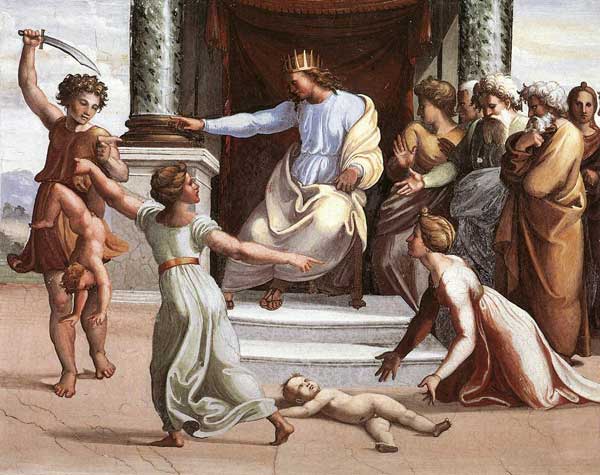
In 1 Kings 3:28, we see the king's prayer answered in practical terms, by the wide approval of his judgment in a tough court case.


(King's Solomon's decision. Image Source, http://pendulumopinions.files.wordpress.com/2009/04/solomon1.jpg)

Proverbs 9:1-6


Wisdom


The word (chakmot) (Proverbs 1:20, 9:1, 24:7) is a later Hebrew form that appears at first glance to be plural (f.), but the -ot ending is more likely an indicator of abstraction. In other words, we are to think of "the overarching concept of wisdom" or "wisdom in the abstract"--or perhaps something almost akin to "wisdom personified" (See Job 28 and Proverbs 8, where Wisdom is a she.) (There is a similar distinction, easily confusing, between Hebrew mamlekah, or mamlekuth [often a particular king's reign or kingdom], the latter perhaps a confusion of the two words, and melukah, malkuth [kingship itself]). Wisdom is a key word in the Old Testament, and one which it pays readers of the Bible to know in the full breadth of its spectrum of meaning:


  • Technical skill in the exercise of some activity: e.g., art, music, architecture, building trades, war, or work. The sort of thing you would learn in a Vocational-Technical School.
  • Administrative ability. The sort of thing you encounter in the best of mayors and governors and plant managers. Ability to arrange things so that the trains run on time.
  • Creativity in the arts. The ability to think "outside the box" in other areas of life, to problem solve, to come up with new solutions for old problems.
  • Savoir-faire, the ability to read and respond to any situation, to do or say what is appropriate to the occasion. The ability to avoid unacceptable and inappropriate social behavior. Also experience or political savvy, the ability to "read" the social context and know what is acceptable or unacceptable to the group.
  • Cleverness or shrewdness, especially in business or financial affairs. The ability to make a buck.
  • Sophistication or worldly wisdom, broad experience of the wider world, foreign cultures and learning, and the like.
  • Prudence, the ability to foresee and avoid gaffes and mistakes.
  • Ethics, decision making that is guided by religious and moral principles. Piety.

The Bible is everywhere clear that God is the source of all wisdom, that wisdom is the tool God used to create the world, and that all human wisdom is less than, and derivative of this divine source. (See Romans 11:33-36, 1 Corinthians 2:16, etc.) The Bible is also everywhere clear that the starting point, the first step or rung, the foundational footing for Wisdom is "the fear [reverence] of the Lord" (Job 28:28, Psalm 111:10, Proverbs 1:7, 9:10, and 15:33). This Wisdom is exemplified by the actions of kings like Solomon and, ultimately, by the ideal reign of the anointed one (messiah, e.g., Isaiah 11:2). The wisdom of God is to some extent revealed (in as much as all people have some sort of wisdom, the wisdom of God is at times only obvious) and to some extent hidden (in that all humans are to some extent and in some areas of life, foolish). When God's wisdom is known to humans, it is a gift, not something earned. Wisdom cannot be gained by pulling on one's own bootstraps. God's full plan, the full extent of God's wisdom, is known to no one and cannot be discovered by the most persistent searching. Not even such powerful forces and mysterious places as death or hell have access to the password for God's store of Wisdom.


Where Wisdom is personified, she is an attribute of the divine wisdom, an attribute of God that is seen in the foundations of the earth, the heights of the skies, the depths of the seas, the innumerable stars, sands, and clouds. She was begotten before the world began; she was birthed to be God's architect and God's blueprint maker for the greatest project of all, the design and construction of the created world, the universe. Wisdom is a professor, a public intellectual, an easily accessible teacher for anyone who will listen on the public airwaves or in the public square. She is inspiring in her presentation, never dull or boring. (The ruach, or Spirit, of God is the "inspire-er" of all human wisdom--the conduit for divine wisdom to humans. This association of wisdom with the spirit is also responsible for the notion that God reveals things to people in dreams.) When Wisdom teaches, even fools learn, kings give good decrees, musicians, artists, and writers create their best works, classics and masterpieces are born.


(When thinking of Wisdom's home, we should envision the temple, e.g., Herod's rebuilt temple in Jerusalem. Image Source, http://www.bible-architecture.info/4.The_16.jpg)

Wisdom's house is quite large and steady. It has seven pillars (Proverbs 9:1). If we are to think of 7 "courses" of pillars, as in Solomon's house (1 Kings 7:2), with it's four courses of pillars topped by cedar beams, then Wisdom's house is larger and more stable even than Solomon's. Whether of stone (the Jerusalem temple) or wood (the tabernacle in the wilderness), these pillars are "hewn" or "cut" and placed with human skill (or "wisdom"). Seven being the number of metaphorical fullness or perfection, perhaps we are to think of an even grander scale and see Wisdom's pillars as the foundations of our world (e.g., 1 Samuel 2:8, Job 9:6, Psalm 75:3), which are always held in place (or shaken, when they shake) by God.


Wisdom's place is one of great hospitality. She has prepared the meat herself, from farm to fork.


(Lamb chops, the food of sacrifice and altar. Image Source, http://www.bbcgoodfood.com/recipes/3678/images/3678_MEDIUM.jpg)

She has mixed the drinks.


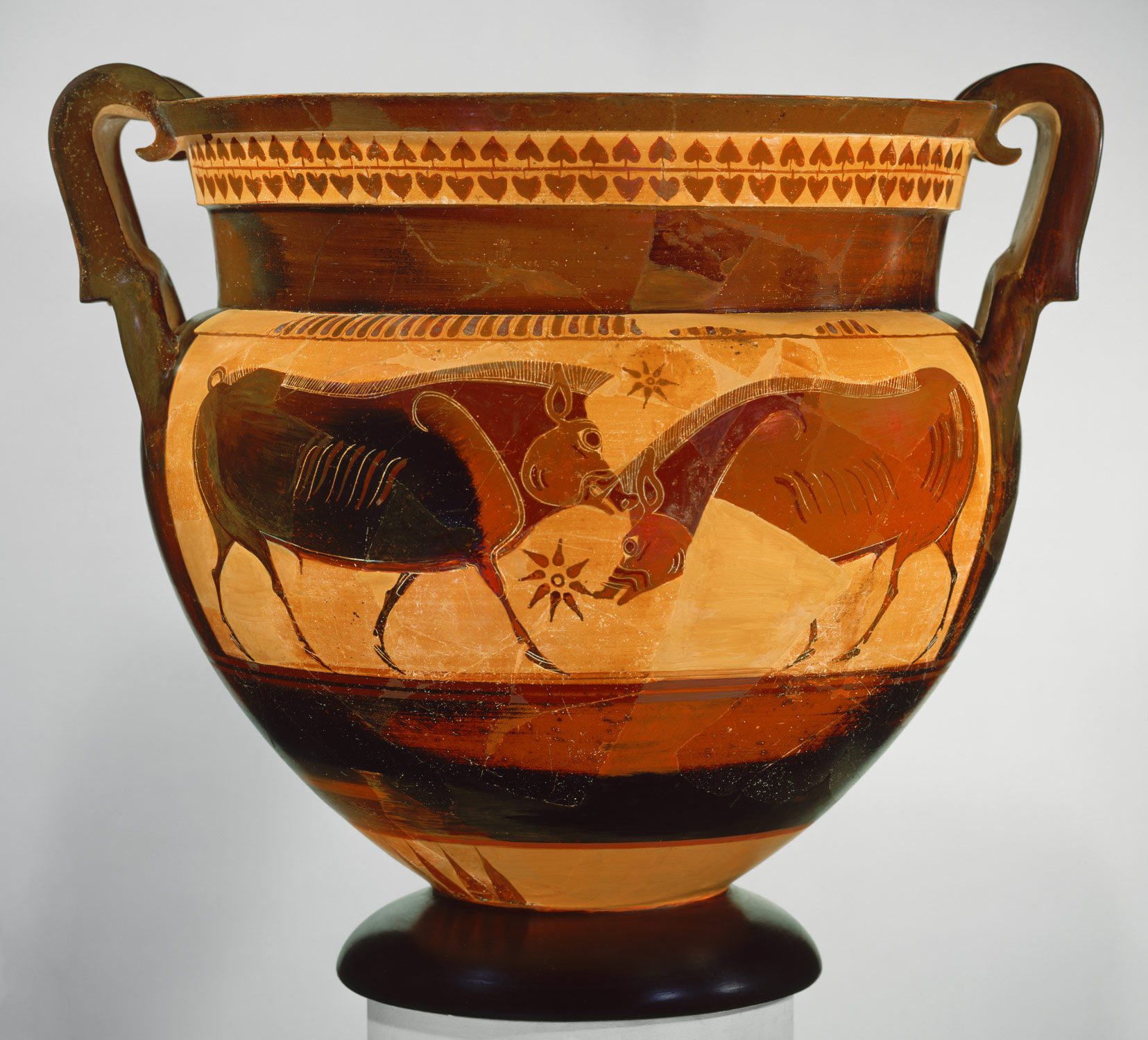
(A vessel for mixing wine and water. Image Source, http://www.metmuseum.org/toah/images/hb/hb_1977.11.2.jpg)

She has set the table.


(Image Source, http://www.whitehousemuseum.org/floor1/blue-room/blue-room-2002-dining.jpg)

Wisdom issues her invitation.


(Image Source, http://www.custodiansofhistory.com/images/LBJ%20%20White%20House%20invite.jpg)

To those who are not yet wise, she extends an invitation. Come, all of you who are simple and senseless, still immature, and let me fill you up. Come, eat the bread and wine that I've set out. If you eat my bread and drink my cup, you will live. You will become mature. You will gain insight.


Psalm 34:9-14


John 6:51-58


Christ, the Word of God, is the logos, or Wisdom of God. (John 1:1, etc.) In John 6, Jesus extends the invitation to Wisdom. Whoever eats the flesh of the Son of Man and drinks his blood will live. The sort of life Christ gives is the same sort of gift Wisdom brings; it is more than mere existence. It is life characterized by the panoply of Wisdom's characteristics (the bullet list above). Christ, the very Wisdom of God, is considered foolishness by the world (1 Corinthians 1:21-24). The only way to Wisdom is to accept his invitation.

Saturday, August 8, 2009

Make Yourself Useful!

1 Kings 19:4-8


The stories about Elijah, especially the wild swings back and forth from emotional high to utter despair and back again that occur in 1 Kings 17-19, are some of my favorite in all of scripture. To see the full context you have to widen your camera lens to include the scene at 1 Kings 17:1, where the prophet says to "evil" (1 Kings 16:33) King Ahab that God has appointed the prophet (Elijah himself) to be the national water spigot: "By the life of the God of Israel in whose presence I stand, there shall be neither dew (tal) nor rain (matar), for a specified number of years (3), except by my command" (lit., "by the mouth of my word"). The implication, born out in the chapters that follow, is that the prophet is in no mood to command rain, because God is in no mood to provide it.


(Image Source, http://library.thinkquest.org/03oct/00494/Drought/images/Drought%202.jpg)

In these days, when most of us are so far removed from agriculture that only with difficulty do we ever make the connection between field and plate--and when most of our food is shipped so far that a drought in our home town or even in our region of the country doesn't immediately lead to a tightening of our belts--the obvious implication of these words might not be evident. But King Ahab must have gotten the message in a hurry.


Of course, water restrictions fall on both the just and the unjust alike, so the prophet--and all of Israel with him--needs to find a reliable source of food and water. Here we see for the first time the dominant theme of these chapters: God will provide for those who work for, who serve or worship, him. So God tells Elijah where to go to find water (Wadi Cherith, Kerith Ravine, "the brook Cherith" which is near the Jordan River, 17:3, 5) and whom to expect (the ravens [`oreb]) to deliver his breakfast and supper there.


(Image Source, http://americanart.si.edu/images/1986/1986.65.294_1b.jpg, http://www.louisglanzman.com/biblemen/withraven.jpg)

Ravens are opportunistic feeders, omnivores, feasting on everything: "carrion, insects and food waste, in addition to cereal grains, berries, fruit and small animals." (See "Common Raven," Wikipedia.) Because of their easy association with humans, it is possible that we are to think of them "sharing" their food with Elijah--or, perhaps as likely, they "share" unwittingly, their presence at food sources pointing the way for Elijah's foraging.


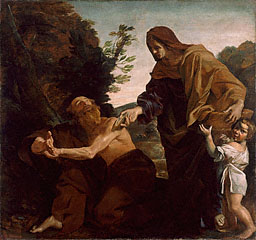
(Lanfranco, 1621-1624; Image Source, http://www.getty.edu/art/collections/images/m/00072701.jpg)

Whatever the case, the wadi soon dried up for lack of rain and Elijah was forced to move on to Zarephath, where he imposed on a widow and her son for water and fried bread, which she protests is a last meal for herself and her son. Once again, Elijah's God ("your God," 17:12) provides, this time with meal (qemach, flour) and oil (shemen) that didn't run out for the duration of the drought. This "best of times, worst of times" saga continues with an abrupt twist when the woman's son falls ill and dies. The prophet, who knows the source of all--both good and bad (light and darkness, weal and woe, or health and sickness; see Isaiah 45:7), asks "LORD have you brought evil [ra`a`, causative or hiph. form] even on the widow with whom I am staying (gur, sojourning)?" Is there perhaps an implication here that the prophet is beginning to resent the heavy hand of the LORD? Nevertheless, the LORD answers by returning to the widow's son his life.


That seems to be the pattern: mountaintop, to death's dark valley, and back to the mountaintop.


But before we get to the mountaintop again, we encounter a comic interlude. We meet Obadiah, who like Elijah is also a servant of the LORD. He has even hidden some 100 prophets illegally, 50 to a cave, bringing them bread and water just as the ravens and the widow had done for Elijah, to protect them from Ahab. Obadiah is out looking for signs of water at the behest of Ahab. The famine has extended so long that the king's horses and mules are beginning to starve for lack of grass. Along the way on his search for grass, Obadiah meets Elijah, whom one might imagine to be a better find even than the grass itself. After all, Elijah is the water spigot, the one for whom (as Obadiah affirms) Ahab has been searching everywhere. But instead of being overjoyed, Obadiah is afraid. He's afraid that Elijah will hide himself again (1 Kings 18:12, "the spirit of the LORD will carry you I know not where"; see John 3:8)--so that when Ahab arrives at that spot in search of Elijah, Elijah will have disappeared once again. After several tries, Elijah convinces Obadiah to rat him out to Ahab. He does. Ahab comes to meet Elijah; and Elijah issues a challenge to the king.


(Image Source, https://blogger.googleusercontent.com/img/b/R29vZ2xl/AVvXsEiKzsLX0UmrOBXgPSRaViZCxfAJ8oLrxbGkk_NgWZeH1Gr2iaf-i6jtzLTg1eIE0a3YYiYSM3nln5OB1k5gBbwPcSeUDmVswYMjPHci33oN73YaYrYmEZ15IPWS45SHfM1iwNRoWCewN8gF/s400/Israel+18+Elijah%27s+View.jpg)

And so we arrive at the summit; on Mount Carmel in the north of Israel there is to be a showdown between Elijah and the prophets of Baal--or, more directly speaking, between the LORD and Baal--for the affection of Israel. And it all has to do with food and water.


This scene is quite well known, so we will not review it, other than to note the following items:


  • The 450 prophets of Baal and the 400 prophets of Asherah eat at Jezebel's table. In other words, they are fed by the queen, not by the deity.

  • The contest is an eating (2 sacrificial bulls) and drinking (water) contest in which Elijah's God devours the sacrifice and laps up the water, but Baal stays completely silent. It is almost as if the LORD has not eaten in a while, that he has endured the same drought as his people Israel, his sacrificial altar having been abandoned (1 Kings 18:30).

  • Elijah is all alone (not quite; he seems quite conveniently to have forgotten the 100 prophets hidden by Obadiah), severely outnumbered.

  • Elijah, in his prayer (18:36), seems to seek some form of vindication, some proof that it is the LORD and not he, Elijah, who had brought the drought and famine on the people.

So it would seem, when the fire flashes from the sky and strikes the mountaintop, that Elijah has finally arrived at the apex of his career as a prophet. He is now vindicated. He has captured the hearts of Israel for the LORD, and he has captured and killed the prophets of Baal (18:40). The drought is now at an end; even the king can go feast, for the prophet "hears the sound of an abundance of rain," the welcome sound of water washing through the wadis (18:41-42).


But as we know, that isn't the end. Ahab tells Jezebel what Elijah has done. Jezebel puts out an APB, prints up a wanted poster, and puts a contract out on Elijah's life: wanted, dead or alive, a prophet of the LORD.


That's the context of our Old Testament reading today. Elijah is wanted, on the run, afraid; he has fled the country. He's back in Death Valley. He's back in the desert with no food or water, and this time with and no ravens or widows to come to his aid. While the rest of the country experiences an abundance, Elijah is enduring his own personal drought.


(George Richmond, 1824-1825; Image Source, http://www.tate.org.uk/collection/T/T02/T02102_8.jpg)


Ephesians 4:25-5:2


Thursday, July 30, 2009

Food Spoilage and the Preservative Power of Faith

Spoilage


...and the preservative power of faith.


Theme: Keep it fresh by trusting God.


Faith is like eating what is local and in season. Putting up--and putting by--canning, freezing, etc.--is like trying to hold on to our "daily bread" for more than one day. Holding on to what we have is like seeking Jesus "just for the signs" and not as our "daily bread," the true bread of heaven.


Context


We know the saying of Jesus in Luke 17:33: "Whoever tries to keep his life will lose it; and whoever loses his life will preserve it." The keeping (peripoieo, "cause to remain over and above"; "acquire, obtain, gain for oneself" BDAG) that Jesus opposes is a striving after more than I need for today, so that by preserving my more I may accumulate wealth and pile up riches--it is a getting of more than I can use today so that I may start ahead of the game of life tomorrow. The "preserving" ("give life, make alive, keep alive" BDAG) is something that only God can truly do (1 Timothy 6:13). That there is some ambivalence about a piling up of goods (and its usefulness) may be seen in a few examples of such "getting" in the Bible: for example, Jacob piles up wealth (Genesis 31:18; but so does Esau, Genesis 36:6) and Solomon has a great personal treasure (1 Chronicles 29:3, but he gives it up for the purpose of building the temple).


How should we understand the ambivalence? Perhaps it is best summed up in the wisdom tradition of Israel with this line from Proverbs: "Those who are generous will be blessed; for they share their bread with the poor." Excess is for sharing, not hoarding--or, in more polite terms, "keeping" or "preserving"--for ourselves. In a counter-intuitive way, by giving away our bread we will preserve it for the day when we need it most. Nowhere is this better seen than in the parable Jesus tells about the rich fool in Luke 12. It is not accidental that the condemnation of this fool for building "even bigger" storehouses is followed by the command not to worry about life (have faith!) and the example of the ravens (who do not sow, but are fed by God) and the lilies (a famine food, like the sycamore and like manna) whose "clothing" is more glorious than Solomon's (who, as we've already seen, accumulated great treasures of his own). The point is that it is better to be "rich in God" (to rely on God completely for all we need) than to "store up treasures for ourselves." That is how Luke 12:33-34 summarizes Jesus' teaching: "Sell your stuff and give money to the poor. Make yourselves reliable, permanent storage units in heaven for your treasure, where it cannot be stolen by thieves or eaten by moths. For where your treasure is, there your heart will be also."


Worms.


Piling up and hoarding, trying to preserve one's life, just attracts flies and leads to worms, which appear in Scripture as a metaphor for death and decay (Job 7:5, 17:14, 21:26, 24:20, 25:6). Worms (maggots) are especially appropriate as symbols of a reversal of fortune--the oppressor king, once a high and mighty accumulator of wealth, bane of the poor--has met his match. The one who was once on top of the world now rests in a grave with worms on top of him (Isaiah 14:11; Acts 12:23). In fact, hell (Gehenna) is conceived in biblical parlance as that place where so much greed and waste has accumulated that "the worm dieth not and the fire is not quenched" (Isaiah 66:24 as quoted in Mark 9:48).


Exodus 16:2-4, 9-15; Psalm 78:23-29


In the poetic form, in Psalm 78, the teacher-psalmist recounts Israel's journey through the wilderness in short, memorable stanzas. The poet's purpose is to hand on from one generation to the next "the song-worthy strength of the LORD, and the wonders he has done" (tehillot, niphle'ot). The poem does this by making a metaphor (78:2, mashal and its relatively close parallel synonym "dark sayings," chiydot) out of a shorthand account of Israel's history. The point is that the younger generation should learn the lessons of their elders and not repeat their mistakes. The younger generation should take the opposite path of the older generation, being faithful instead of faithless, loyal instead of traitorous.


The verses that concern us today (23-29) are set up by the preceding stanzas, which alternate between what God has done (deliverance from Egypt, guidance through the wilderness, provision of water in the desert) and what a previous generation of Israel has done (craving the food of Egypt, straying from the road-map drawn up for them, testing God's provision). The set up is concluded with verses 18-20, when they now demand food in addition to water, asking the provocative question whether God is able to "set a table" in the desert (vs. 19, using language similar to that of Psalm 23:5, "you set a table in the presence of my opponents"). God's response, though angry, is once again to provide for his people in abundance.


The scene is perhaps better known in its prose version from Exodus 16, where the yearning for what they've escaped ("the fleshpots of Egypt," 16:3) is explicit and the juxtaposition with their joy at deliverance (Exodus 15) is stark. Another account of the manna is given in Numbers 11, where the desert food is contrasted with the fish, the cucumbers, melons, leeks, onions, and garlic of Egypt (11:5-6). And yet another short hand version of Israel's history is given in Nehemiah 9 (see verse 20), where the dramatic outline is the same and manna is again given a supporting role. The story in Exodus 16 contains more details than the poem, including specific instructions regarding how much manna to gather each day (1 omer [1/10 ephah] per person per day, except in preparation for the Sabbath, when they would gather twice as much because there would be no gathering on the Sabbath), the command not to gather more on any one day than they needed (to gather only their "daily" bread), and information about what happened when the previous two instructions were disregarded: 1) excess manna spoiled and became wormy, and 2) those who did not gather twice as much on Friday went hungry on Saturday.


Manna? "Whaddayacallit?"


According to Exodus 16:31, manna was like coriander seed,


(Image Source, http://thymeforfood.files.wordpress.com/2008/07/coriander-seed-7.jpg)

white, with a taste like honey crackers. The same description is given in Numbers 11, with the addition that the color was that of "gum resin." Both accounts indicate that it appeared without effort on the part of the people in association with the dew fall (over night, so that it was available in the morning), but that it had to be gathered or collected for use. Numbers 11 adds some detail regarding the ways it was processed for eating:

ground in mills,


(Image Source, http://www.mindspring.com/~breadforlife/grinder.jpg)


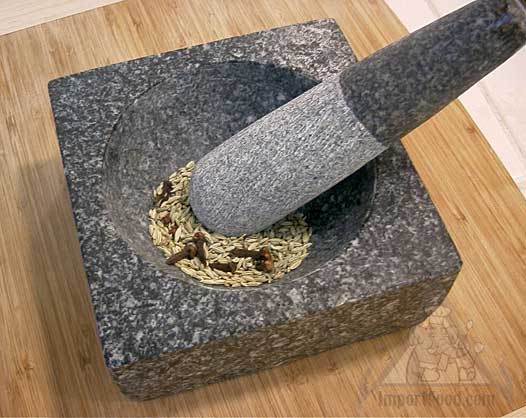
beat in mortars,


(Image Source, http://importfood.com/media/mortarpestlesq_3l.jpg)


boiled in pots,


(Image Source, http://shininghappypeople.net/rwotd/media/blogs/rwotd/kasha.jpg; a nice blog article on the use of boiled grains in Russian cooking.)


made into cakes.


(Image Source, Kate in the Kitchen, http://cooknkate.files.wordpress.com/2009/03/millet-cakes-001.jpg?w=499&h=375. Of course the Israelite version of millet cakes would have been sans leeks, greens, and PORK!)


Clearly manna was used in the same sorts of way any grain, e.g., wheat, maize/corn, or rice, would have been had they been located permanently in an arable land. Because of manna's association with "the heavens" as its source--evidently because of the serendipity of its appearance and its association with the source of the dew (or rain)--manna was also called the "grain of heaven" or "heavenly food" (e.g., Psalm 78:24 and Psalm 105:40; see 1 Corinthians 10:3). This heavenly association--its grace-filled, merciful serendipity and the reference to its source--is the reason for the famous formulation: "one does not live by bread alone, but by every word that comes from the mouth of the LORD" (Deuteronomy 8:3, NRSV). Its name, manna, appears to be a play on the phrase "what is it?" (man hu', Exodus 16:15).


So what is this mystery food? Here are a few suggestions from the natural world (as opposed to the miraculous or supernatural). One thing to keep in mind is that manna is "famine food," desert food; the equivalent of the "lily of the field" or the "sycamore tree."


Alhagi maurorum (Sinai manna, camelthorn)


(Image source, Israel Plant Gene Bank database, Alhagi maurorum, http://igb.agri.gov.il/main/resultat11.pl?GENUS=Alhagi&SPAUTHOR=Medik.&SPECIES=maurorum)

A sweet tasting manna is produced from the twigs at flowering time.


Tamarisk gallica


(© 1995 Saint Mary's College of California. Image source, CalPhotos, Tamarisk, http://calphotos.berkeley.edu/cgi/img_query?query_src=photos_index&seq_num=13138&one=T).

AKA saltcedar for its salinity tolerance. Considered a noxious weed, an invasive plant, in the USA. (See the USDA Plant profile for Tamarix or Tamarisk and the Invasive Tamarisk page at Earlham College.) There is some reporting of a sweet and mucilaginous manna produced in response to insect damage to the stems. See Plants for a Future (Tamarix or Tamarisk, http://www.pfaf.org/database/plants.php?Tamarix+gallica).

Fraxinus ornus (flowering ash, or manna ash)


(Image Source, Colors, Issue 69, http://www.colorsmagazine.com/issues/69/index.php?page=13).

Manna in this case comes from an incision in the living wood of the tree to which a fishing line has been attached so that the sap will flow down, forming a white tube that can be gathered when it has hardened.

John 6:24-35


The connection of John 6 with the Old Testament lection and the Psalm for this week comes from Jesus' claim to be "the bread that came down from heaven" (John 6:41, one of Jesus' I AM sayings).