Showing posts with label Christmas. Show all posts

Thursday, December 17, 2009

Santa's Cause is Something Profound

As we continue our Advent series, Rediscover Christmas: Finding the True Christmas Story in Classic TV Christmas Specials, we come to the 1970 animated musical, Santa Claus is Coming to Town, directed by Jules Bass and Arthur Rankin, Jr., narrated by Fred Astaire, and with Mickey Rooney as Santa (Kris). While many will decry the "commercialization" and the "secularization" of Christmas represented by this annual TV special, I think the True story of Christmas is evident in it everywhere and needs hardly even to be pointed out.


Once again we find in the story the usual stock characters: the unreformed evil lawmaker and enforcer, Mr. Burgermeister Meisterburger, and the quickly reformed and warmed Winter Warlock. The plot is also quite familiar to us, as Mr. Kluger proceeds to explain over the course of some 48 minutes everything we've ever heard about the big fat man in the bright red suit.


More about this gift-giver extraordinaire later. For now, let's just say that gift giving has become for many of us the least True aspect of Christmas as it is celebrated today. The way we give and receive gifts may seem to us more a chore or duty than a grace, or worse, a compulsion and addiction. But for most of us, we have been programmed since early childhood (and the stories of Santa) with a gut-level understanding that Christmas is about "stuff." Stuff under the tree, stuff we give to others, stuff we bake, stuff we hand out at the office, stuff we collect, and stuff that is discarded by Easter. As Anna Quindlen put it so perceptively and succinctly in Newsweek last December, "Stuff is Not Salvation." Quindlen was writing in response to the death of a Wal-Mart shopper who was trampled on "Black Friday," the Friday after Thanksgiving (2008): her conclusion, we have "an addiction to consumption so out of control that it qualifies as a sickness."


(Image source, http://www.ashleybristowe.com/weblog/content/binary/The%20ridiculous%20loot%20pile%20-%20SM.jpg)

How do we redeem that? Is there some meaning in gift-giving and receiving that is a bit more sane, a bit less desperate, a bit less an addiction? The gifts of Christmas are too often now to us just so much stuff. Gift giving and receiving feeds our culture of incessant greed, covetousness, and acquisition. We have forgotten the real meaning of Christmas giving, so it is the True meaning of gift giving and receiving that needs more than anything else to be Rediscovered about Christmas.


(Image source, http://guiltycarnivore.com/wp-content/uploads/makenna-xmas.jpg)

First, let's discuss the theme of "giving" in today's scripture selections.

Isaiah 60:1-7


This is one of my favorite scriptures. It provides an extensive elaboration of one of the most significant aspects of the Zion Tradition, a tradition about God's choice (Psalm 78:68 and 132:13) and blessing of Jerusalem as his dwelling place, a tradition best identified with King David and his descendants. Zion is that name we use for Jerusalem when we want to speak of it in terms that are True; it is the theological name for the City of David (2 Samuel 5:7), the real counterpart to the all-too-political city, Jerusalem. According to the Zion Tradition, the fact that YHWH God has chosen to make his home there (Psalm 9:11 and 76:2) means that Jerusalem will be a place of great importance. Though the temple mount is not by any means the highest mountain in Israel, it will "be exalted" to a place of world-wide significance (Psalm 48:2) as the place where international disputes are arbitrated (Psalm 133). Zion would be an ancient U.N. or World Court of sorts (Isaiah 2:1-5), but with God as the sole judge (48:11) and lawmaker by means of his chosen representative, his "son," Israel's king, the "Great King" of all the earth (Psalm 2:6-7 and 48:2). Zion is the place where world peace moves from possibility to reality (Isaiah 2). Zion is the place from which the glory of God shines (Psalm 50:2) and can be seen near and far. It is a place to which pilgrims come (Psalm 84:5). It is a place to which tribute ["gifts"] is brought (Isaiah 18:7, Psalm 68:18, 29; 72:10; 76:11-12; 45:12). Even after Jerusalem has been destroyed by the Babylonians and the people of Judah taken captive, the True meaning of Zion's blessed estate is the refuge of Israel's prophets (Isaiah 49 and 60, Haggai 2:1-9).


The point of "gift giving" in the Zion Tradition is to make public our recognition of God's sovereignty. God is king and rules over all of life. We bring our offerings in humble recognition and acknowledgment of his Lordship and in gratitude for his blessings (which blessings are the original source of the very gifts we bring; we give him what he has first given us, we return to him what already is his).


Matthew 2:1-12


The Zion Tradition shows up in the Christmas story in the form of Magi, "wise men from the east," kings who came to Jerusalem (aka, Zion) bearing gifts.
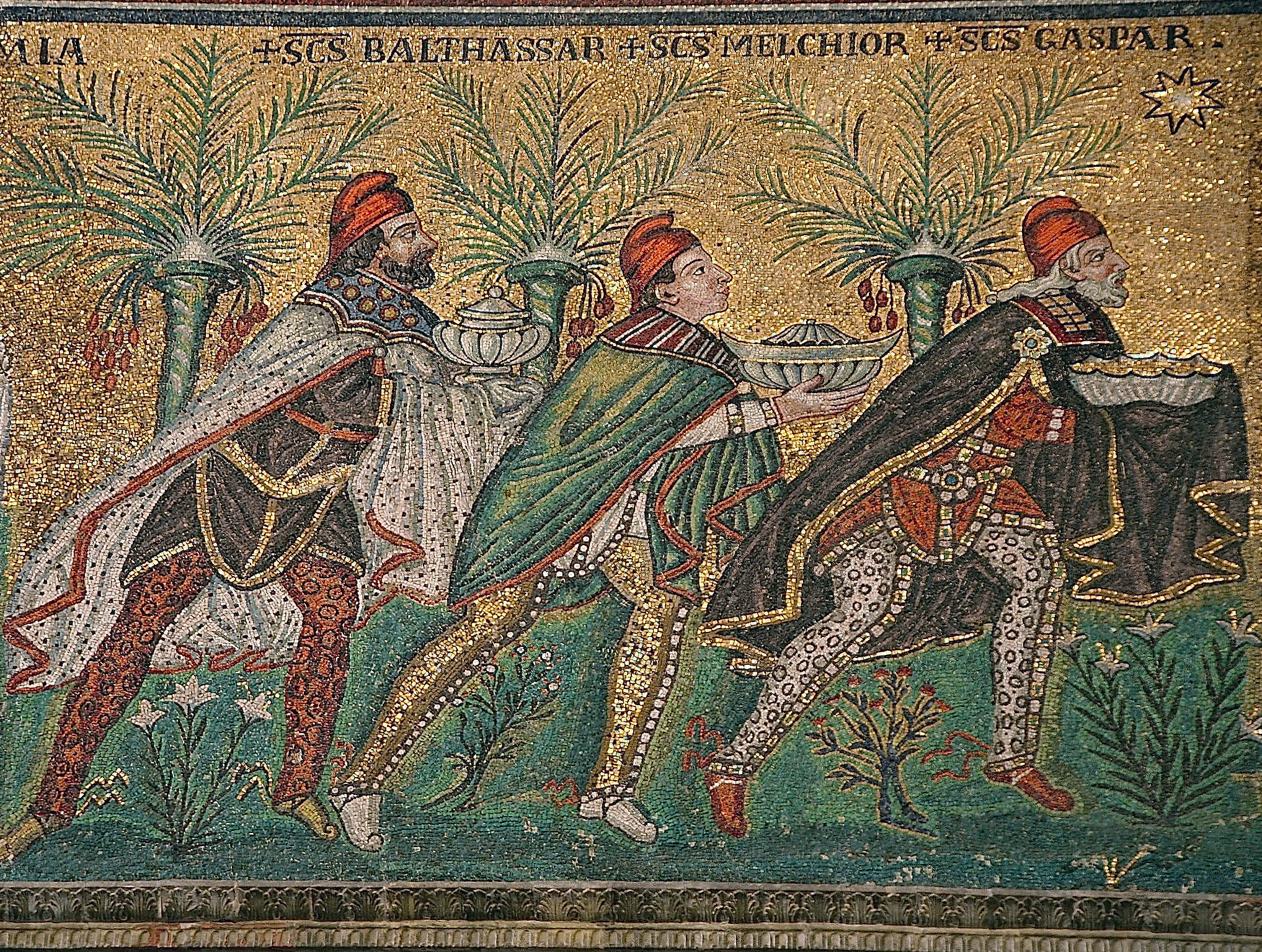


(Image source, http://commons.wikimedia.org/wiki/File:Magi_(1).jpg)

They stopped there in the big city first, but were then directed to a small, out-of-the-way place, the town or village of Bethlehem, also a "city of David," but more like the place of David's humble shepherd origins, not his later royal situation. This boy child they recognize as God's vice-regent on earth, a king, the "son" of God and they have come to "pay homage" and give tribute ("gifts"). These Magi have been led to Jerusalem by a star (the glory of the Lord shines forth from Zion), which comes to rest over the place where the boy was. Everything that Zion represented as the place where God has chosen to dwell with humankind (Immanuel, God with Us) has now been conferred on a child. Salvation, protection, redemption, the "hopes and fears of all the years" are placed here. This is the place and the one to whom we now bring our gifts. Jesus, the Christ, the baby in a manger--or the young child growing up--is now God with Us, our Immanuel. He is the source of "Peace on Earth" and good will. (In the story of the Magi, Herod plays the role of Mr. Burgermeister Meisterburger, or the Grinch, or Scrooge, the anti-hero, maker of war, etc.)


So, what does all this have to do with Santa Claus? Glad you asked. If we are to redeem some meaning in all this Christmas gift giving, we must start with our culture's gift-giver-in-chief, Mr. C himself. We have to answer that age-old question of childhood, "Do you believe in Santa Clause?" There are, of course, hundreds of other questions asked by kids when they reach 5-7 or 8 years of age: "Why does Santa come on Jesus' birthday?" "Why does he give us gifts?" "Who is Santa anyway?" (You'll find an ongoing list of questions, and the debate about how parents should respond to questions from their children about Santa, at the NYTimes this week.) Those questions are the ones with which the Rankin and Bass TV special begins, with the letters read by "Special Delivery" man Kluger (S.D. Kluger), voiced by Fred Astaire. (Perhaps it is worth noting the recent interruption and restoration of the long tradition of answering children's letters addressed to Santa Clause, North Pole.)



(Image source, http://images4.wikia.nocookie.net/christmasspecials/images/thumb/b/b2/SD_Kluger.jpg/282px-SD_Kluger.jpg)

The "point" of the TV special is to explain every detail of the Santa legend by means of a single, convoluted story plot line. But Kluger fails to explain what is perhaps the most significant detail of all, the "Clause" medallion.


(Image source, http://kathleenhalbert.com/resources/Santa.jpg)

If Kluger had bothered to notice the "Clause," the one good, glaring clue to the origin and identity of the mystery man in red, he might have made his way past the accreted traditions and myths to a "real" person, an historical, once living person, known as Niclaus, or Nicholas. Saint Nicholas, to be precise. We Protestants do not "believe in" saints, of course, at least not in the same sense as Roman Catholics do. But even we who hold to the "priesthood of all believers" do recognize that some folks like Mother Theresa of Calcutta and Pope John Paul II represent lives of sacrifice and faithfulness to which we may with benefit aspire. The problem for most of U.S. protestants is that we know little or nothing about the life of Nicholas that would lead us to see him as an example of deep faith and to try to emulate that faith. We do not know much about this once-and-future living legend, but we do know some things more than Kluger reveals. (Note: for a great web site devoted to exploring and explaining the Christian roots of Santa Clause, you cannot do better than The St. Nicholas Center. Another, much shorter and less detailed, "history of Santa" may be found at history.com.) We know, for example that he was born probably around the year 280 in the region of Lycia in Asia Minor (modern Turkey), spoke Greek, and was made bishop of Myra, a place where St. Paul stopped on his way to Rome (Acts 27). He was likely a successor, 5 or 6 generations later, of the leaders Paul would have known.


(Image source, http://lasvegasorthodox.com/images/St._Nicholas_of_Myr.jpg)


During the first part of Nicholas' ministry, it was illegal to be a Christian in the Roman empire. Nicholas was alive and active during the last and greatest persecution of Christians under Diocletian (303-313). He was also a representative to the Council of Nicaea (325), where the church declared its faith by adopting one of only two universal creeds, the one known as the Nicene Creed:

We believe in...one Lord Jesus Christ, the only-begotten Son of God, Begotten of the Father before all worlds; God of God, Light of Light. Very God of very God, Begotten, not made, Being of one substance with the Father; By whom all things were made; Who, for us men, and for our salvation, came down from heaven, And was incarnate by the Holy Ghost of the Virgin Mary, And was made man.


Nicholas believed in Jesus was our Immanuel, God with Us. Nicholas faced imprisonment and death for holding fast to such beliefs. For this faith he was willing to suffer.


(Image source, http://img2.allposters.com/images/NGSPOD/1033777.jpg)

Nicholas was remembered for his gift giving and compassion. He was a believer full of joy and generosity. The overflowing joy of his salvation expressed itself in him through the giving of secret gifts. It was said that he often left gifts where those who were most in need would be sure to find them, on the hearth, in clothes by the fireplace, in stockings left drying, in shoes at the entrance to the house. (One of the most famous is about his intervention with a dowry for young women whose families could not afford to have them marry.) He often gave money, and for that reason he is often depicted with three golden orbs.


It seems that Nicholas lived life as a joyful response of faith in Christ and the Good News of salvation. The gospel was the center of Nicholas' life, so the gifts he gave were not merely gifts, they weren't just so much stuff, they were a response of praise and worship at the birth of the king.


(Image source, http://www.heqigallery.com/GALLERY%20NT%20A/images/14_the_magi.jpg)

Saturday, November 28, 2009

It's a Wonderful Life

Rediscover the True Meaning of Christmas in the Classic TV Christmas Specials


(See Midnight Oil, below.)

Some of my pastor friends will accuse me of having crossed over to the dark side to join in the crass commercialization of Christmas, but I beg to differ. The idea for this sermon series, and the series itself as it has thus far been developed, was the brainchild of one of the pastors in my *covenant group. It has since been preached by all of us (or almost all) except me--and, purportedly, with good results. As the pastors in our group have taken it on in turn, the ideas and resources have accumulated (including some from pastors who have independently developed similar series, and now there are also some available from professional media resources like Midnight Oil Productions), demonstrating what fertile ground there is here. Another pastor friend of mine is always reminding me to meet my congregation on any given Sunday "right where they are." At this time of year, we are completely inundated with media messages about Christmas. Very soon, each and every TV special in the series will be shown, most more than once, on multiple TV broadcast and cable channels. A quick walk into the local department "super-" store (WalMart [TM], Target [TM], etc.) will reveal that these movies are the ones at the top of the shelves--they are the moving images and sounds that create the atmosphere, the context and background for our holiday preparations and family celebrations for the next month. They will be the source of late night jokes, casual references, and allusions in news stories.


Not that we'll be buying everything they are selling. We aren't and we won't. But if we needed some legitimation for preaching the gospel in this mode, we couldn't do better than appeal to Jesus himself. The stock characters and situations in many of Jesus' parables likely originated in the moral and ethical culture in which he was born and grew up. If there had been classic movies in Jesus' childhood, I'm sure he would have used them. When Jesus began to tell the story about the profligate (prodigal) son, for example, everyone around him probably nodded their appreciation, perhaps even predicting that the boy would wind up in a pig pen.


(Image source, http://d1shzm2uca9f83.cloudfront.net/large/remb_vz_varken.jpg)

They had heard this story before. The recognized the characters and the plot. Maybe they could even predict the young man's remorse, his repentance and his return home. But I doubt very much that they predicted the reception with which his father greeted him, or the upheaval in the older brother's expectations. (Luke 15:11-32)


(Image source, http://www.jneiman.com/images/058-prodigal-son.jpg)

Or, to cite another, when Jesus started out a story by telling his audience that "a man was going down from Jerusalem to Jericho,"


(Image source, http://farm3.static.flickr.com/2121/2314500564_fc8ff751a6.jpg)

they may have been able to finish the first sentence without any help: "and fell into the hands of robbers, who stripped him, beat him, and went away, leaving him half dead." People traveling that road were always being mugged. But how many times had their version of the story ended with a Good Samaritan's good deed? (Luke 10:30-37)


(Image source, http://www.wwoaw.net/The%20Good%20Samaritan%20after%20van%20Gogh%20and%20Delacroix%201024%2080.JPG)


As we pursue the telling of the Advent Gospel of expectancy as it appears in the characters and situations of the TV Christmas Classics, we will be on the alert, identifying both where the movies have and, perhaps more importantly, where they haven't followed the twists and turns of the Christmas Story from which they often draw their inspiration.


There are too many such classic movies for any one 4- or 5-week sermon series. I have seen all of the following movies suggested and used more-or-less to good effect: Rudolph the Red Nosed Reindeer, It's a Wonderful Life, Frosty the Snowman, How the Grinch Stole Christmas, Santa Claus is Comin' to Town, Jack Frost (a character in several of the animated classics), The Year without a Santa Claus, The Little Drummer Boy, and A Charlie Brown Christmas.


This year, we will be looking at 5 of the classics (4 Sundays of Advent + Christmas Eve).

November 29, It's a Wonderful Life

Zephaniah 3:14-20, Matthew 20:1-16

December 6, What Rudolph the Red Knows

Isaiah 9:2-7, John 1:1-18

December 13, Sympathy for the Grinch

Isaiah 53:1-5, Luke 1:67-79

December 20, Santa's Cause is Something Profound

Isaiah 60:1-7, Matthew 2:1-12

Christmas Eve, 7:00 pm

December 24, A Charlie Brown Christmas Eve


I'll blog a few ideas about the series each week, beginning now with the 1936 Frank Capra classic, It's a Wonderful Life (60th Anniversary Edition), starring James Stewart and Donna Reed.


Plot Summary, Wikipedia Summary.


What themes from the true meaning of Christmas appear in the movie?

  • Humility and Self Sacrifice, for the sake of others. (Philippians 2:5-11)

    Saint Augustine of Hippo (354-430), in a famous Christmas Sermon (Sermon 187), rings the changes on this aspect of the Christmas story in his own inimitable way: "Maker of the sun, He is made under the sun. In the Father he remains, From his mother he goes forth. Creator of heaven and earth, He was born on earth under heaven. Unspeakably wise, He is wisely speechless. Filling the world, He lies in a manger. Ruler of the stars, He nurses at his mother's bosom. He is both great in the nature of God, and small in the form of a servant." (Translation source, "Reflections," Christianity Today, Vol. 41, no. 14, Dec. 8, 1997)


    No less a preaching light than C.H. Spurgeon could fill a whole sermon (and then some) with reflections on the fact that there was "No Room for Christ in the Inn." Many others have done the same, drawing on images old and new to illustrate the sort of humility that Christ took on.

    In the movie, George Bailey planned all his life to travel the world, to go to "Italy, Greece, the Parthenon, the Coliseum.” He plans when he returns from his world tour to attend college. Then, he’s going to “build things… airfields, skyscrapers a hundred stories high…bridges a mile long.”


    (Image source, http://nighthawknews.files.wordpress.com/2009/07/its_a_wonderful_life_02.jpg)

    One by one, George turns all these things down. Eventually he also turns down Mr. Potter’s outrageous offer of a lucrative $20,000/yr. salary – a salary that would more than have provided for his future wife and children.


    (The evil millionaire, Mr. Potter. Image source, http://avltheatre.com/ruben/potter.jpg)

    On the day of his wedding/honeymoon with bride Mary [!], on his way out of town [once again!], there’s a run on the bank. People are panicking like it's 1933, and they want their money.


    (Jimmy Stewart in "It's a Wonderful Life, image source: http://open.salon.com/blog/megan_stewart/2009/01/07/files/jamesstewart4601231343406.jpg)

    (Oh, wait, it probably is 1933 or thereabouts, because of the flashback from the final setting: Christmas Eve, 1946; George and Mary married in 1928.) The evil millionaire Mr. Potter sees this as his opportunity to take over the bank, and the town. Once again, George lets go of his rights and lays down his life so he can serve the townspeople – by using all but $2.00 of his honeymoon money to save the bank from collapse. In other words, George Bailey spends his entire life giving up his big dreams for the good of Bedford Falls.


  • Why do bad things happen to good people?

    OR
  • Does my life really make a difference? Does it matter at all that I lived? (Job 3:3)

    The title, or subtitle of this sermon might be, "Living a Life that Counts for All Eternity." The movie was, after all, loosely based on the short story "The Greatest Gift" by Philip Van Doren Stern. On Christmas Eve of 1946, George is broken and suicidal over the misplacing of an $8000 loan (lost by his Uncle Billy while bragging about brother Harry's accomplishments and recognition in the war) and the evil schemes of his nemesis, Mr. Potter. George crashes his car into a tree during a snowstorm and runs to a nearby bridge to commit suicide, feeling he is "worth more dead than alive" because of a $15,000 life insurance policy.


    (Image Source, http://esl-bits.net/scripts/WonderfulLife/images/wl_100208.jpg)

    George's guardian angel, Clarence, comes to earth to show George how his town, family, and friends would turn out if he had never been born. George has meant so much to so many people; should he really now just throw it all away? The angel, Clarence, shows George throughout how his town, his family, and his friends would have turned out if he had never been born. George meant so much to so many people; should he really just throw it all away?


  • A Reversal of Fortune (Zephaniah 3:14-20, Matthew 20:1-16)

    After Clarence shows George what life would have been like for so many others if he had not been born (Bedford Falls = a slum, Pottersville; Mr. Gower in prison; Uncle Billy in an insane asylum; Harry dead), George prays to live again. Meanwhile the whole town has also been praying for George. His friends and family have collected a huge amount of money to rescue him. His brother Harry arrives just in time to propose a toast to his brother, "the richest man in town." Seeing how many lives he has touched, and the difference he has made, George Bailey truly does have "a wonderful life."


    (Image source, http://www.calendarlive.com/media/photo/2006-12/27020557.jpg)

The comparisons with the parable of the Laborers in the Vineyard in Matthew 20:1-16 are somewhat obvious. Jesus' parable is bracketed (19:30 and 20:16) with statements about reversals of place and situation in life: "the first shall be last and the last shall be first." Like an oldest male child (and like George), these first disciples--and especially Peter, James, and John (20:21)--are acutely aware of what they have sacrificed to take on the responsibilities they hold. ("We have left everything to follow you, so what will we have?") That is the set up, the context for Jesus' telling of the parable. The eldest child, the first disciples, and the first workers understand there to be an implicit agreement that the return will be commensurate with the investment of time and labor, that those who work and give more will also get more. But Jesus says that the one who bears ultimate responsibility will also pay the ultimate price (20:17-18). The reward, resurrection life, only comes after crucifixion death. It is this promise--the turning of bankruptcy to restored fortune, shame to praise, oppression to benefaction, mourning song and funeral dirge to festival music and dancing, rejection to acceptance, exhaustion to renewed and inexhaustible capacity for living, hate to love, sorrow to joy and gladness, conflict to reconciliation, judgment and condemnation to redemption and grace, enemies to friends, and disaster to salvation--that is the theme of the song of joy in Zephaniah 3:14-20. The last scene of the movie, the last page of the story is one of restoration and salvation for Job, for George, for Israel, for us, for the disciples--all because also for Jesus himself, crucified and resurrected.

*My covenant group is made up of four great friends from seminary days at PTS, David Casson (Sandia Presbyterian Church, Albuquerque, NM), Jeff Chandler (First Presbyterian Church, Bakersfield, CA), John Hartman (Wake Forest Presbyterian Church, Wake Forest, NC), and Stephen Oglesbee (Clear Lake Presbyterian Church, Houston, TX). We meet every year for conversation, study, prayer, ...and sermon series idea exchange! Thanks, guys.