Acts 11:1–18
Peter's Defense
Peter, who is back "home" in Jerusalem with his friends and relatives, the other "apostles" and the "circumcised believers," now has to defend his actions in baptizing and welcoming Cornelius, a centurion, to the Way. Luke is careful to describe Cornelius as an "upright" and "God-fearing" person, but the only characteristic of Cornelius that the Jewish church leaders can see is that he is "uncircumcised," and therefore "unclean." The real question for Peter is, "Why did you eat with them?" (Acts 11:2)
Peter, whose temporary address "in Joppa, with Simon the tanner by the sea" we discussed last week,

© Copyright 2010 by Debbie Rockey. Peter at Simon the Tanner's House, Acts 9:43. Image rights available ($2.50) for church use.
takes his friends through the journey step-by-step. Like a scientist or mathematician explaining a complicated formula or a coach diagramming a complicated play, Peter recounts the journey from Dorcas to Simon's house to the house of Cornelius. He tells how he was praying (he leaves out the part this time about being up on Simon the Tanner's roof and hungry) when he fell into a trance and saw a vision.
© Copyright 2010 by Debbie Rockey. Peter's Vision of a Large Sheet, filled with unclean animals, four-footed animals, reptiles, and birds of the air, Acts 10:11. Image rights available ($2.50) for church use.
One of the details that stands out in Acts 10 (and in the shortened re-telling in Acts 11) is Luke's focused attention on hospitality:
- Arrival of the Needy. Acts 10:17 (retold in 11:11). "Real men" don't ask for directions, especially when they can just follow their noses! But these men, who were sent (apestalmenoi) by Cornelius, arrive at the right place by asking about the location of the house. These ambassadors arrive "at the gate" (pulona, Greek; Vulgate, ianua, door; see Luke 16:20, where Lazarus is laid at the "gate" of Dives).
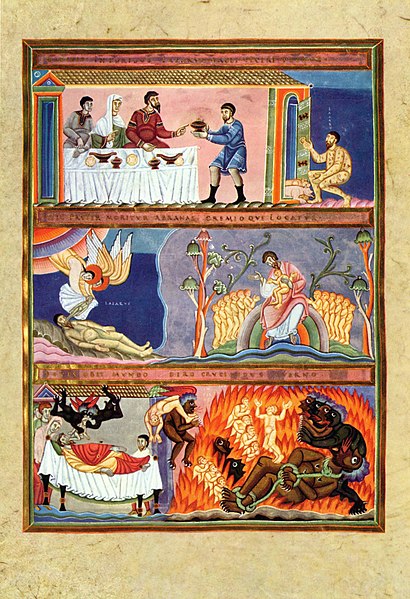
(Image source, http://upload.wikimedia.org/wikipedia/commons/thumb/6/64/Meister_des_Codex_Aureus_Epternacensis_001.jpg/410px-Meister_des_Codex_Aureus_Epternacensis_001.jpg)Their arrival on the threshold demands a response of hospitality.
- Multiplication of Hospitality: The Power of Exponential Growth. Acts 10:22-23 (retold in 11:13).
--Summoning a Good-News-Speaker. Cornelius is instructed by an angel to "send for" Peter. (metapempo, a compound used only by Luke in the New Testament, also used of Felix summoning Paul to "listen to him speak about faith in Christ," Acts 24:24.) Cornelius brings Peter "into his house" (something done also by Jairus to Jesus in Luke 8:41), so that Cornelius may hear what Peter has to say (rhemata para sou). The Greek word rhema, like the Hebrew word dabar, may take on specialized meanings according to context. The basic meaning is "word, saying, expression, or statement of any kind" (BDAG), but it can mean prophecy, prediction, commandment (as in the Ten Commandments, "words"). In this case it probably means preaching or teaching. It appears in some well known sayings, such as "Nothing is impossible with God." (Luke 1:37, more woodenly and literally translated: "For every word [rhema, thing] will not be impossible with God.") In other words, what God says is true, and comes true (Luke 1:38, 2:15, 17, 19, etc.). Divine words spoken will be realized. Divine words will become real things, events, objects, matter--just as the world itself was "spoken" or commanded into existence. >
>
(Image source, https://blogger.googleusercontent.com/img/b/R29vZ2xl/AVvXsEjQlU_IcGeNqLSvAk6mPnTmrjEdGWRwjcyuS9ERrzZ4by4-yGlcEdWI8LeS5beL7hxstyLrur_9Qf-9EnuI-KwjF8TQ3IKpOLavK7Gc2lRSxhKYWsyMjVLULFagBSD84A_oc7HDpcvZKqU/s1600/Peter-teaches-Cornelius'-household.jpg)--The Recipient of Hospitality Offers Hospitality. Peter, a guest himself with Simon the Tanner, offers the new arrivals hospitality--which will also be reciprocated by Cornelius when Peter arrives at his house. Luke tells us first that Peter is "staying with" (xenizo, receiving hospitality from, being entertained as a guest by) Simon the Tanner (Acts 10:6; also 10:32). Then, as we've said, that the men asked if this is the house where Peter is "staying" (Acts 10:18). And, finally, that Peter invites the men to "stay" with him at Simon the Tanner's house. (Acts 10:23) Luke uses this word xenizo advisedly. Luke is pointing out that Peter is staying as a "stranger" in Simon the Tanner's house, and that Peter is entertaining people he has not previously met in the house of someone he does not know. What's more, Peter will speak words that are "strangers" to their ears, as Paul did to the people of Athens in the Areopagus (Acts 17:19-20).
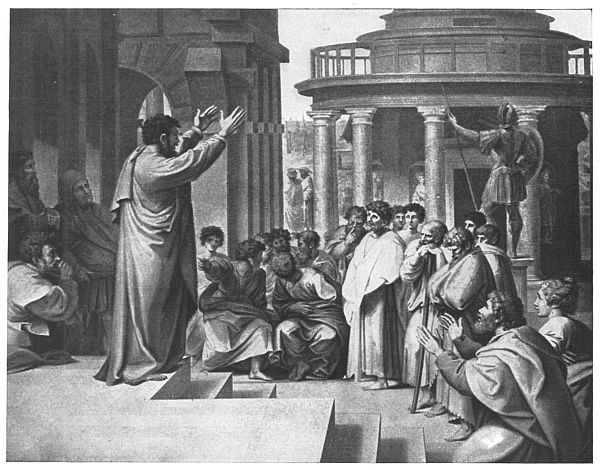
(Image source, http://www.gutenberg.org/files/23580/23580-h/images/illus373.jpg)According to Luke, Peter and Simon the Tanner and Cornelius are all heeding the as-yet-unwritten admonition of the writer of the book of Hebrews: "Do not neglect to show hospitality to strangers, for by doing that some have entertained angels without knowing it." (Hebrews 13:2, NRSV)
- Entertaining Angels, literally! Acts 10:30 At first glance this verse has no other import (as if it needed any more) than to indicated the means by which (a divine messenger) Cornelius was directed to Peter. However, the messenger's "fine clothes" (en estheti lampra) are an indicator of high social class, wealth, and prominence. We know that Cornelius, a Roman centurion, will welcome someone who is well-dressed to his home, but will he also welcome Peter, whose clothes still reek of Simon the Tanner's profession?
My brothers, as believers in our glorious Lord Jesus Christ, don't show favouritism. Suppose a man comes into your meeting wearing a gold ring and fine clothes, and a poor man in shabby clothes also comes in. If you show special attention to the man wearing fine clothes and say, "Here's a good seat for you," but say to the poor man, "You stand there" or "Sit on the floor by my feet," have you not discriminated among yourselves and become judges with evil thoughts? (James 2:1-4, NIB)
The whole of James 2 is a condemnation of any sort of favoritism. Favoritism negates the good of our hospitality as a demonstration of faith. So the question becomes whether Cornelius will take the angel's advice to seek out Peter, a man he doesn't know, whose address at the smelly home of Simon the Tanner who lives by the sea. (Acts 10:32)
- Responding Well by Doing Good and Being Present. Acts 10:33. Cornelius commends Peter (kalos epoiesas, "you did well") for making the right choice to respond to the summons and demonstrates his own response both in sending for Peter and in gathering his house (enopion theou, "before God") to hear the strange words that Peter brings ("whatever the Lord has commanded you to say," panta + prostasso).
- Staying. Acts 10:48. The sort of work that is done by the rhema has both its immediate results (reception, initiation, baptism) and its longer-term effects. God's initiative in this sequence of events is clear to Peter, in the vision of the lowered sheet, in the knock of strangers at the door, in the visit of an angel to Cornelius, in the receptivity of Cornelius and his family to the Word of faith, and in the pouring out of the Holy Spirit "just as on us at first." For the Word to take root and grow in Cornelius and his family, however, Peter cannot be a "hit and run evangelist." Peter must remain ("abide") for a few days with these new gentile disciples, eating and drinking with them. The work begun is too important to leave immediately. Peter is an instrument of the word proclaimed, it is God who has begun and will complete this good work in them.
John 13:31–35, 36-38
The scene is the table for the Lord's Supper after communion is over (bread mostly eaten, cup mostly empty), Judas is leaving or has just left to betray Jesus. Jesus gives the disciples a "new" commandment that they love one another just as he has loved them. He promises that this love will be their identifying mark as disciples of Jesus in the world. The shadow of the cross of Jesus falls heavily in anticipation across the scene. It falls across Jesus and the disciples, including Peter. (Peter vows that he will follow Jesus to the death. Jesus' response makes me wonder whether we can relate the three times Peter denied to the three times the sheet was lowered and the three men who arrive at the same moment from Cornelius' house.) The scene of the foot-washing is a preview of the sort of sacrifice required to form the sort of community God desires, full of the sort of love that engenders hospitality for the stranger and fellowship without partiality. The growth of the kingdom is based on this deep love, hospitality and fellowship.
 Peter Greenaway has created a 'son et lumiere' of Leonardo's Last Supper, http://www.theage.com.au/news/entertainment/arts/arts-reviews/leonardos-last-supper/2009/10/12/1255195742166.html?page=fullpage. (Image source, http://images.theage.com.au/ftage/ffximage/2009/10/14/supper_narrowweb__300x446,0.jpg)
Love God, and love your neighbor as yourself. Who is my neighbor? My neighbor is the stranger who offers me hospitality in his stinky house, the people who show up on my doorstep, people with whom I have major disagreements and minor squabbles, people whom I cannot stand but for the grace of God. In order for the wind (Spirit) to continue blowing as it did at first, love must continue strong among the disciples of Jesus.


 (Image source, http://upload.wikimedia.org/wikipedia/commons/d/d9/Leather_tanning%2C_Fes.jpg)

 Posts
Posts