1 Kings 19:4-8
The stories about Elijah, especially the wild swings back and forth from emotional high to utter despair and back again that occur in 1 Kings 17-19, are some of my favorite in all of scripture. To see the full context you have to widen your camera lens to include the scene at 1 Kings 17:1, where the prophet says to "evil" (1 Kings 16:33) King Ahab that God has appointed the prophet (Elijah himself) to be the national water spigot: "By the life of the God of Israel in whose presence I stand, there shall be neither dew (tal) nor rain (matar), for a specified number of years (3), except by my command" (lit., "by the mouth of my word"). The implication, born out in the chapters that follow, is that the prophet is in no mood to command rain, because God is in no mood to provide it.

(Image Source, http://library.thinkquest.org/03oct/00494/Drought/images/Drought%202.jpg)
In these days, when most of us are so far removed from agriculture that only with difficulty do we ever make the connection between field and plate--and when most of our food is shipped so far that a drought in our home town or even in our region of the country doesn't immediately lead to a tightening of our belts--the obvious implication of these words might not be evident. But King Ahab must have gotten the message in a hurry.
Of course, water restrictions fall on both the just and the unjust alike, so the prophet--and all of Israel with him--needs to find a reliable source of food and water. Here we see for the first time the dominant theme of these chapters: God will provide for those who work for, who serve or worship, him. So God tells Elijah where to go to find water (Wadi Cherith, Kerith Ravine, "the brook Cherith" which is near the Jordan River, 17:3, 5) and whom to expect (the ravens [`oreb]) to deliver his breakfast and supper there.

(Image Source, http://americanart.si.edu/images/1986/1986.65.294_1b.jpg, http://www.louisglanzman.com/biblemen/withraven.jpg)
Ravens are opportunistic feeders, omnivores, feasting on everything: "carrion, insects and food waste, in addition to cereal grains, berries, fruit and small animals." (See "Common Raven," Wikipedia.) Because of their easy association with humans, it is possible that we are to think of them "sharing" their food with Elijah--or, perhaps as likely, they "share" unwittingly, their presence at food sources pointing the way for Elijah's foraging.
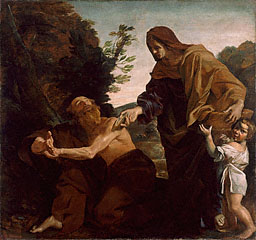
(Lanfranco, 1621-1624; Image Source, http://www.getty.edu/art/collections/images/m/00072701.jpg)
Whatever the case, the wadi soon dried up for lack of rain and Elijah was forced to move on to Zarephath, where he imposed on a widow and her son for water and fried bread, which she protests is a last meal for herself and her son. Once again, Elijah's God ("your God," 17:12) provides, this time with meal (qemach, flour) and oil (shemen) that didn't run out for the duration of the drought. This "best of times, worst of times" saga continues with an abrupt twist when the woman's son falls ill and dies. The prophet, who knows the source of all--both good and bad (light and darkness, weal and woe, or health and sickness; see Isaiah 45:7), asks "LORD have you brought evil [ra`a`, causative or hiph. form] even on the widow with whom I am staying (gur, sojourning)?" Is there perhaps an implication here that the prophet is beginning to resent the heavy hand of the LORD? Nevertheless, the LORD answers by returning to the widow's son his life.
That seems to be the pattern: mountaintop, to death's dark valley, and back to the mountaintop.
But before we get to the mountaintop again, we encounter a comic interlude. We meet Obadiah, who like Elijah is also a servant of the LORD. He has even hidden some 100 prophets illegally, 50 to a cave, bringing them bread and water just as the ravens and the widow had done for Elijah, to protect them from Ahab. Obadiah is out looking for signs of water at the behest of Ahab. The famine has extended so long that the king's horses and mules are beginning to starve for lack of grass. Along the way on his search for grass, Obadiah meets Elijah, whom one might imagine to be a better find even than the grass itself. After all, Elijah is the water spigot, the one for whom (as Obadiah affirms) Ahab has been searching everywhere. But instead of being overjoyed, Obadiah is afraid. He's afraid that Elijah will hide himself again (1 Kings 18:12, "the spirit of the LORD will carry you I know not where"; see John 3:8)--so that when Ahab arrives at that spot in search of Elijah, Elijah will have disappeared once again. After several tries, Elijah convinces Obadiah to rat him out to Ahab. He does. Ahab comes to meet Elijah; and Elijah issues a challenge to the king.

(Image Source, https://blogger.googleusercontent.com/img/b/R29vZ2xl/AVvXsEiKzsLX0UmrOBXgPSRaViZCxfAJ8oLrxbGkk_NgWZeH1Gr2iaf-i6jtzLTg1eIE0a3YYiYSM3nln5OB1k5gBbwPcSeUDmVswYMjPHci33oN73YaYrYmEZ15IPWS45SHfM1iwNRoWCewN8gF/s400/Israel+18+Elijah%27s+View.jpg)
And so we arrive at the summit; on Mount Carmel in the north of Israel there is to be a showdown between Elijah and the prophets of Baal--or, more directly speaking, between the LORD and Baal--for the affection of Israel. And it all has to do with food and water.
This scene is quite well known, so we will not review it, other than to note the following items:
- The 450 prophets of Baal and the 400 prophets of Asherah eat at Jezebel's table. In other words, they are fed by the queen, not by the deity.
- The contest is an eating (2 sacrificial bulls) and drinking (water) contest in which Elijah's God devours the sacrifice and laps up the water, but Baal stays completely silent. It is almost as if the LORD has not eaten in a while, that he has endured the same drought as his people Israel, his sacrificial altar having been abandoned (1 Kings 18:30).
- Elijah is all alone (not quite; he seems quite conveniently to have forgotten the 100 prophets hidden by Obadiah), severely outnumbered.
- Elijah, in his prayer (18:36), seems to seek some form of vindication, some proof that it is the LORD and not he, Elijah, who had brought the drought and famine on the people.
So it would seem, when the fire flashes from the sky and strikes the mountaintop, that Elijah has finally arrived at the apex of his career as a prophet. He is now vindicated. He has captured the hearts of Israel for the LORD, and he has captured and killed the prophets of Baal (18:40). The drought is now at an end; even the king can go feast, for the prophet "hears the sound of an abundance of rain," the welcome sound of water washing through the wadis (18:41-42).
But as we know, that isn't the end. Ahab tells Jezebel what Elijah has done. Jezebel puts out an APB, prints up a wanted poster, and puts a contract out on Elijah's life: wanted, dead or alive, a prophet of the LORD.
That's the context of our Old Testament reading today. Elijah is wanted, on the run, afraid; he has fled the country. He's back in Death Valley. He's back in the desert with no food or water, and this time with and no ravens or widows to come to his aid. While the rest of the country experiences an abundance, Elijah is enduring his own personal drought.

(George Richmond, 1824-1825; Image Source, http://www.tate.org.uk/collection/T/T02/T02102_8.jpg)





 Posts
Posts