(Image source, http://www.eaglegiftsgalore.net/Papers/Morning%20Mist.gif)
As the writer makes clear in the prolog (1:1-2), the addressees are believers, "saints [hagiois] and faithful [pistois] brothers in Christ." That is why he so readily assumes (2:6) that they already "received" Christ Jesus the Lord. His concern is what course of life they will follow now. His exhortation is that these brothers and sisters in Christ live (peripateite, literally "walk") in Christ. It is as if Christ were one of two (or more) paths (courses or directions) in which their life might go. They, having received Christ, are encouraged by the apostle to continue on their way in Christ without hesitation, backtrack, detour, or regret.

(Image source, http://scienceblogs.com/framing-science/Crossroads.jpg)
The two images that follow supplement the metaphor of the pathway from two different realms of life. First, the apostle likens "walking in Christ" to putting down roots ('errizomenoi). In other words, life in Christ should be like life in God (Psalm 1), like the person who delights in the "Torah" (teaching) of YHWH" and meditates on that teaching regularly. Such a person is "planted" like a tree on streams of life-giving water. Such a person avoids walking, standing, or sitting on that other (bad/evil) path.

(Image source, iStockphoto.com, by John Woodcock)
The second image is drawn not from the world of nature, but from the world of human artifice. People who live in Christ are being "built-up" ('epoikodomoumenoi) on Christ.

(Image source, http://chestofbooks.com/architecture/Better-Homes/images/Concrete-Block-Foundation.jpg)
Like the wisdom psalm (Psalm 1), which gives equal consideration to both the good path and the bad, the apostle considers the sorts of things that might cause his brothers and sisters to stray from the good path (2:8, 16, 18, 20-21). These are things that might be used to capture and carry the saints down the path of slavery (sulagogon). Especially worrisome to the writer are "philosophy and empty deception," ways of life that are based on human tradition and how the world supposedly works, rather than on Christ. These other roads are not real roads. These false paths are, in reality, nothing of consequence. Any of them that might have been powerful enough at one time to attract and hold the saints have now been subjected to the rule of Christ. The holding power of human tradition and norms has been removed--de-clawed, de-fanged, and otherwise decommissioned with respect to our mode of living by our baptism (a spiritual circumcision that cut us off from the power of the flesh). The physical rituals that sometimes entice our interest as alternative paths are but shadowy outlines and weak imitations of powerful spiritual realities--i.e., food, drink, new moons, festivals, and sabbaths can only trip us up now if we allow them to be used to judge (krino) or condemn us (i.e., allow someone other than Christ to be our Lord). They are puny approximations. Christ is the reality. In the same way, we should not allow anyone to steal our prize (katabrabeuo).

(Image source, http://blog.masslive.com/leftbank/2008/05/small_051027_sn_UmpireTN.jpg)
There are those who will want to rule against us like a bad umpire whose ability to take away the win is limited to our acquiescence to his bad calls. In the day when this epistle was written, such umpires were calling the saints "out" (or "foul") when they did not make a show of humility (through physical abuse of the body; see verse 23) or show proper respect to angels, or put enough credence in elaborate visions.

Such people, the apostle says, are too proud of their worldly intellect. They are ordering people not to handle, taste, or touch material things, as if such things matter. Do not listen to them or you will end up on the wrong path.
The right path involves grabbing hold of Christ, who is the head from whom the whole body--being held together and supplied by joints ('aphon, "connections") and fastenings (sundesmon)--grows with the growth that only God can give (see Ephesians 4:15-16 and Colossians 1:6, 10).
What sort of growth is that? It is the sort of weedy growth exhibited by the lilies of the field (Matthew 6:28, Luke 12:27), which receive and provide grace and beauty without toil. It is the sort of growth exhibited by the tiny mustard seed, which matures from the smallest of seeds to the largest of trees (Matthew 13:31-32, Luke 13:19). It is like the farmer's seed that falls on good soil (Mark 4:8), multiplying 40X, 60X, or even 100X. It is the sort of growth spurt that newborn babies have that first insatiable year of milk craving (1 Peter 2:2). It is the sort of growth spurt that a child who is favored and specially marked by the Holy Spirit will enjoy, gaining strength, wisdom and grace (Luke 1:80 and 2:40). But it is also the sort of growth enjoyed by the church in Acts, when "the word of God continued to spread [and] the number of the disciples increased greatly" (Acts 6:7, NRSV; also Acts 12:24, Acts 19:20). It is the sort of growth you see on a major construction site when the steel starts to go up (Ephesians 2:21). It is the sort of growth that requires multiple workers, often workers who are at odds with one another as well as those who are working in cooperation, always acknowledging and "overflowing with thanksgiving" always because it is God who actually provides the growth. One plants and another waters, but it is God who grows stuff (1 Corinthians 3:6-7). It is the sort of growth that results in more righteousness, good works, and stronger faith and an increase in all the other fruit of the Spirit (2 Corinthians 9:10, 10:15; Colossians 1:6, 10). It is the sort of increase that happens despite the odds against it, as in the case of the Hebrew slaves in Egypt. In other words, it is the sort of growth that Pharaoh and his minions cannot kill (Acts 7:17), especially as the time grows near for deliverance.
Being on the right path means being on the path of growth in Christ, a path of supernatural growth. It is not natural. But neither is it artificial. The sort of growth imagined by Paul for the church, organic but supernaturally strong (not artificial), is had only by prayers such as the one Jesus taught his disciples and the sort of desire for the kingdom that he also cultivated in them.
Let it never be said that the Bible lacks a sense of humor. Today's story is about Naaman, a Syrian captain, whose name in Hebrew means "beautiful" (masculine form of Naomi, mother-in-law of Ruth). The root occurs in Ugaritic (na`amanu) and (possibly) Amorite (nachmanu), and is the Semitic name for the deity also-known-as Adonis (Wikipedia link; note the two-fold connection of "rebirth" [killing and making alive, 2 Kings 5:7] and youthful beauty).
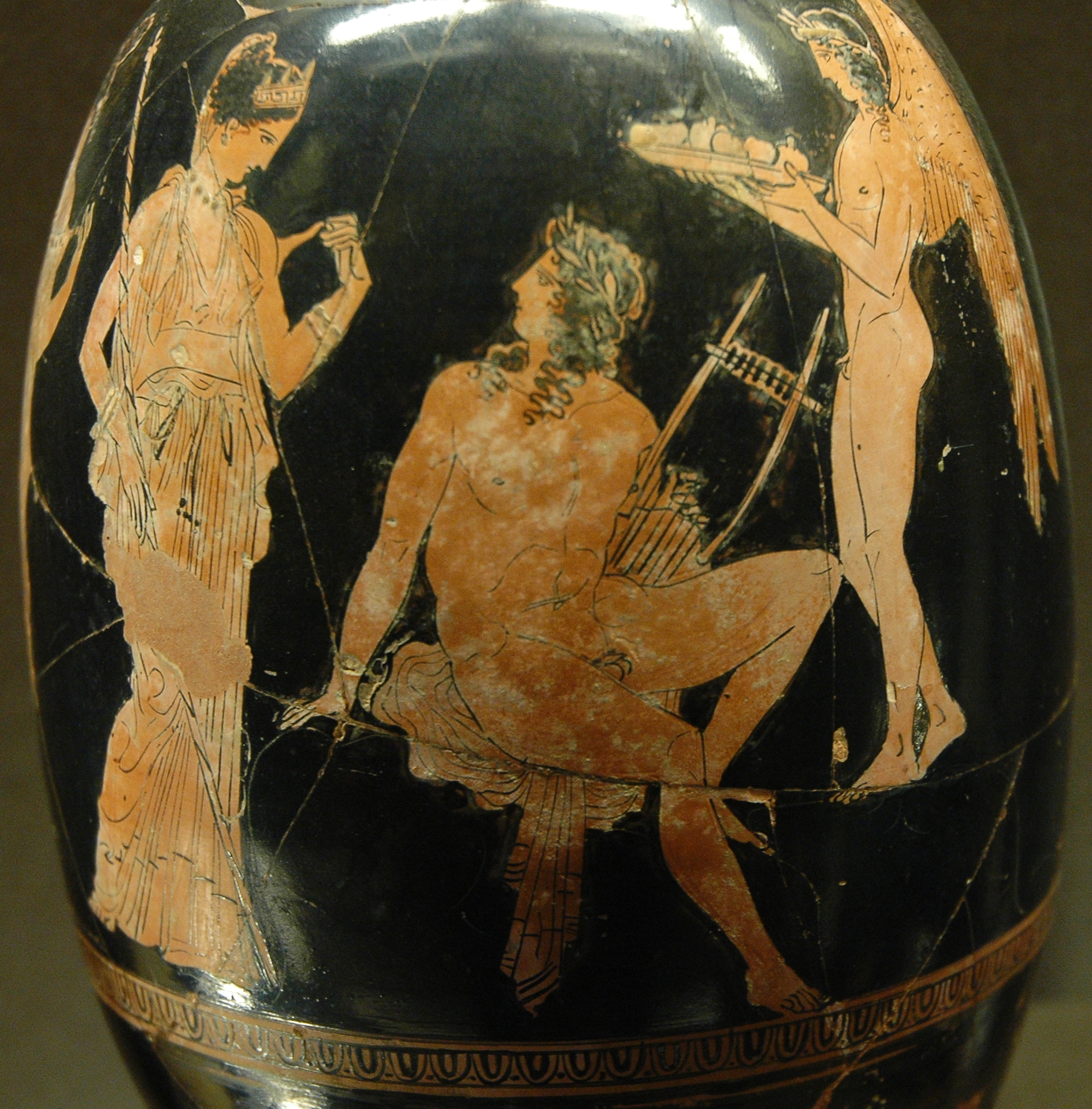
The crescendo of praise for Naaman that builds throughout the first verse crashes abruptly with a single word at the very end of the sentence: we are startled to learn that this foreign beauty is afflicted with leprosy, a terrible, disabling, disfiguring skin disease. This dream of a man, for whom the world is his oyster, who is an army commander, a V.I.P., always welcome in the corridors of power, a winner, a great warrior and a man of great strength, has been struck with the disease of those who are poor, malnourished, vulnerable and weak.
The irony of this story continues unabated as an offer of help comes to the great man Naaman in the form of a small, captive, nameless servant girl from a defeated country. In another reversal of great and small, the captive servant girl's own words are quoted verbatim in the court of the king. Then, when golden boy Naaman departs to obtain his healing, we come to the heart of things. Naaman expects to purchase his salvation from the prophet in Samaria with a boatload of stuff: ten talents of silver, six thousand shekels of gold, and ten suits of clothes. These "things" are are the tools for Naaman's "advance team."
The irony intensifies as Naaman approaches the king of Israel with a letter (another thing that "prepares the way" for Naaman) demanding healing. How is Naaman (or his boss, the Syrian king) to know that the king of Israel and the prophet in Samaria (and the prophet's God, YHWH) do not get along well and are usually on opposite sides of Israel's wars of religion? The king responds to the letter immediately by tearing his clothes (a visible sign of distress) and tells the truth (at least rhetorically): Am I a God? Am I able to kill and bring back to life? I cannot save this man from leprosy! But the king in Samaria also assumes that the Syrian king has an ulterior motive in making such an unreasonable demand, to pick a fight, to create an excuse to invade this vassal kingdom again.
Elisha, who just last week took on the mantel of Elijah, saves the day. Elisha invites the king to send Naaman to the prophet's own house. So, Naaman and his stuff arrive, expecting hospitality befitting his V.I.P. status. But Elisha doesn't invite him to come inside. Instead he sends out a messenger (mal'ak, an angel, like the little servant girl from whom Naaman has already received help) with instructions to go and wash seven times in the river Jordan. Because the prophet himself did not come out (notice the parallel with Jesus' sending of the seventy in Luke 10), Naaman is angry. His expectations regarding the mode for his salvation have been disappointed. He is not being treated with the deference and respect he demands. In a huff of superiority, he declares that the waters of his own land are better than those of Israel. He sulks away in a smoldering rage.
In another reversal of big and little things, it is once again the servants who save the day, reminding their master that he would have gone to any (great) length to secure his health, so why not do this (little) thing? The reading ends with Naaman's obedience and healing. Like Adonis, he is reborn. His skin is new like a baby's.


Once again, Jesus sends out disciples (see 9:2) to preach the Kingdom of God and to heal those who are sick, like Naaman. The difference is that whereas Naaman sought out the prophet (and people often sought out Jesus), these disciples seek out the sick. Going from town to town, they have the job of getting folks ready for the coming of Jesus. They are the advance team, testing the receptivity of the town and the hospitality of its people and providing a foretaste of the Kingdom that is coming near.

Making preparations for an "event" can sometimes be as intense as hosting the party itself. It is in the making of arrangements that money is committed, relationships are formed, and the work of the advance team makes or breaks an event. Some venues and cities are better hosts than others, but even the best will not live up to full potential without good advance work.
The disciples could be excused for thinking that they needed "stuff" to roll out the red carpet for Jesus and the Kingdom. Like the Indianapolis Host Committee for Super Bowl 2012, they may feel the pressure to perform well.

(Image source, http://www.insideindianabusiness.com/images/news/logos/SuperBowlBidlogo.jpg)
And for that, they need "stuff," right? They need improved facilities, money, clothes, shoes, etc. They need to make a great impression, to polish their image, to "sell" the Kingdom event to those influential people whose acceptance or rejection of their message means so much.
But Jesus is having none of it. Like Elisha, he is refusing the "stuff" and reinforcing the message that the Kingdom of God comes to town on the dirty, dusty feet of little servant girls and poor disciple messengers. These are feet without shoes, people without money, without extra changes of clothes. They bring one thing only, the message of peace. As they heal the sick, they say that the Kingdom of God has come near. They eat what they are given and go where they are told, stay where they are welcomed and move on when they are not.
Discipleship does not require a lot of packing. Are you ready? Leave your stuff. Forget your list. The harvest is plentiful, but the laborers are few. Have your feet been reborn? Are they in the picture? Is your name written in heaven? Then rejoice!

© Copyright 2010 by Debbie Rockey. Disciple Feet, Luke 10:2. Image rights available ($2.50) for church use.
The passage from 2 Kings begins much as today's reading from Luke 9 (below). When YHWH was about to take Elijah up to heaven in the storm wind, Elijah and Elisha [his disciple] set out from Gilgal on a journey. Elijah asks his student to stay put, while Elijah goes on to Bethel. But Elisha replies to Elijah much as Peter does to Jesus, and with the same desire expressed by two of the would-be followers of Jesus in today's reading from Luke, "I will not leave you." So they continued along the road to Bethel, ... and then on to Jericho (2:4-5), and finally to the banks of the Jordan.
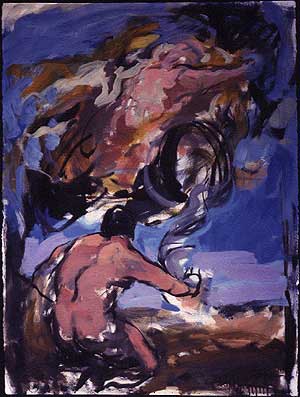
(Image source, http://www.ecva.org/exhibition/substance/images/knippers.jpg)
The connection between the Exodus of Elijah and that of Moses is cemented in Luke's gospel with the ministry of Jesus on the Mt. of Transfiguration, just prior to the passage we take up today (Luke 9:28-36). One similarity and a great difference between the departure of Elijah and that of Jesus is the effect it has on the disciples. The Spirit of Jesus does descend when the day of Pentecost "has fully come." And it descends with the promise of even greater works and the mantel of the authority of Jesus' ministry. But the journey of Jesus is not merely the journey of a servant of God. The Son of Man was God's own Son, and when we set out with him, it is the complete transformation of our lives and our world that ensues. It is we who are transformed.

(Image source, http://elaynelaporta.com/gallery/images/medium/ot_elijah-fiery-chariot_MED.jpg)


 , p. 827). The reception of Jesus, his word and his servants, has become a recurring theme in Luke 8 and 9, starting with the parable of the sower (8:13, those who "receive" the word gladly, but have no roots) and continuing with instructions to the disciples who are headed out on a preaching and healing mission (9:5). Jesus tells the disciples to shake off the dust of any place that does not "receive" them as a testimony against the people of that place. This basic rule of hospitality is turned into a responsibility for all disciples in 9:48, where receiving "this little child" (or "the least among you") is tantamount to receiving Jesus and the One who sent Jesus. In this case, the people of the Samaritan village reject Jesus specifically because his traveling destination is Jerusalem (9:53). They are rejecting him and refusing him hospitality not because of his previous acts but because of his forward trajectory.



We begin with the story of Elijah. While it is not our primary focus this week, the story does provide some serendipitous points of contact that may help to illumine our reading of the Gospel of Luke. Between the story of Elijah's raising of a dead boy (I Kings 17:8-24, 10th Sunday in Ordinary Time) and this story of Elijah's flight from Jezebel toward Mt. Horeb lies a mountain-top experience of another kind (Mt. Carmel, I Kings 18), a conflict between Elijah and the religious establishment of Israel in which Elijah very much enjoyed the upper hand. I Kings 19 begins with a reference to that prior victory over the prophets of Baal on Mt. Carmel, but then turns suddenly to the presentation of a contemporary threat. There is a sports cliche that comes to mind here: "you are only as good as your last game." In other words, Carmel is over--it is ancient history now--and Jezebel stands ready to challenge Elijah's freshly won claim that his God, YHWH, is superior to her god, Baal.
You might think that a guy who had recently resuscitated a corpse and called down fire from heaven might exude a little confidence. You might expect him to indulge a little swagger. But not today, not Elijah. His mental game is off. His mind isn't in it. He's not trying; he's stopped looking for a strategy to move ahead in the race. He's not even looking to tie. And he's given up on keeping body and soul (nephesh) together. He hasn't the courage, the strength, the heart, the ________ (you fill in the blank) that is required to keep going. He is ready to sit one out, to warm the bench, maybe to quit the team for good. He has lost the will to win. He is sated with the struggle. He says, "Enough already!" (rab `attah; see 2 Samuel 24:16 // 1 Chronicles 21:15) Elijah just wants to curl up under a broom tree and die. He needs someone who understands what he has been through. He needs someone to care that he's been trying all this time to make a difference, but that the cards seem stacked against him. I think he needs an Extreme Makeover.
You know the show.
It is a "reality show" (a misnomer of a genre if ever there were one). The show's premise is that there are real people in this world who are right now struggling against incredible odds to do the right thing. They may be winning a few battles here and there--they may even seem tragically heroic--but they are obviously losing the war. The whole of life seems hopelessly stacked against them. Without some "miraculous" intervention, without some sort of extraordinary good luck, they are going under. They may as well throw in the towel now unless they get help. And they do not need just a little help. They need a complete reshuffling of the deck. The genius of the show is that it has discovered the perfect symbol for this transformation: it is the demolition and rebuilding of the family's house. Given how we "worship" our homes (at least we did once, before the recent Great Recession), it is somehow deemed appropriate that the complete transformation of a family's life be narrated as the awe-inspiring story of a house transformed. In just a matter of days, in seemingly miraculous fashion, the family's old home is destroyed and a new home is constructed in its place, with the help of friends, neighbors, and community.
The question is whether Elijah gets this sort of transformational help when he calls out to God.
Elijah does get help. He receives a hot meal or two delivered by the deacons. (1 Kings 19:5-6, 7-8) He gets some much needed rest while he is "dropping out" and taking a little spiritual R&R. While on his "vacation" he attends the Mt. Horeb church, the same place where Moses went, for a spiritual retreat. He is hoping for a little revival of the spirit, some encouragement, maybe a burning bush or an eleventh commandment, earthquake, fire and smoke. But instead of allowing him to settle in and take his ease, God asks Elijah point blank what he's doing there. (mah-lekah poh; the only other time such a question is asked of someone seeking a refuge, Isaiah 22:16, it is clearly an unfriendly question: "What right have you to be here? Who gave you permission?")
Why are you here? God asks the question twice. (1 Kings 19:9, 13) Both times, Elijah answers the same.
I have been very zealous for the LORD, the God of hosts; for the Israelites have forsaken your covenant, thrown down your altars, and killed your prophets with the sword. I alone am left, and they are seeking my life, to take it away.(I Kings 19:10, 14; NRSV)
After YHWH repeats the question and Elijah repeats the answer, it seems that YHWH's "help" with Elijah's transformation comes in the form of an acceptance of Elijah's resignation. (1 Kings 19:16) However, two tell-tale signs contradict that assumption: first, Elijah is told to "go back the way you came" (shub ledarkekah)--in other words, go home, to your old place; and, second, he is commissioned to anoint two kings (Hazael of Damascus, a foreign king; and Jehu, king of Israel). This is perhaps the most significant assignment of his prophetic career; it is hardly a retirement. In fact, the anointing of his successor could be seen as "life insurance" taken out before embarking on hazardous duty. Whatever Elijah was seeking when he came; he received what he needed to continue as a prophet. Sometimes, perhaps, what we need is not an Extreme Makeover, but a swift kick in the pants.
According to Paul, the coming of Christ, our faith in Christ and our baptism into Christ, represent an Extreme Makeover. Our lives have been transformed from their former state of slavery and imprisonment to a state of freedom as adopted children and heirs of God's promise. We were sinners under a great debt and in danger of immediate foreclosure and homelessness; but now we are justified, paid up, by faith with a new lease on life. In our new life in the Spirit, there is no prejudice, no distinction, based on the old realities that had things stacked against us: there just isn't a difference now in our family between Jew and Greek, male and female, slave and free. We are all one in Christ. Even our closets have been transformed, even our clothes have changed, to demonstrate this new reality.
But before we get too comfortable with this new life, we should ask whether there is an example of the aftermath of such a complete life transformation. Have others survived it?
Between last week's table talk (Luke 7) and this week's demoniac comes the parable of the sower (8:4-15) and the comment from Jesus about setting one's light on a lampstand (8:16) and (on hearing that his mother and brothers are looking for him) that his real family is "those who hear the word of God and do it." (Luke 8:21) Then we come to the story of the demoniac, which coincidentally begins with a change of scenery. Jesus and his disciples set out across the lake in a boat and while they are under sail Jesus falls asleep. When a storm blows up and threatens to capsize the boat, the disciples call out for help. ('apollumetha, "we perish"; it is the equivalent of the "demolition" required by an Extreme Makeover.) Jesus quickly comes to their aid, not transforming their lives, but rescuing them from impending death in the storm. The winds and the waves, and their obedience to Jesus, are impressive and clearly connected to the transformational power of faith, but they leave the disciples, like Elijah before them, with more questions than answers. (Luke 8:25)
When they arrive, Luke points out again that they are not at home. They are in the country of the Gerasenes (or Gadarenes), which is the opposite ('antipera) side of the Sea of Galilee. (Luke 8:26) A man comes out to meet them who is in dire straits. Even the Extreme Makeover folks would have difficulty knowing where to start because the man has neither home to demolish nor clothes to throw away. His home is in the tombs. (mnemasin; Luke's only other use of the term in the gospel is for the tomb of Jesus, the sepulcher with the stone across the front, Luke 23:53 and 24:1, and for the tombs of David [Acts 2:29] and Abraham [Acts 7:16]). Having just read I Kings, we cannot avoid hints of Elijah's cave on Mt. Hebron here. But the demoniac in Luke throws us a curve. The demoniac demands of Jesus an answer to the same question God posed to Elijah: "What are you doing here?" More to the point, "What do you want with me?" This is, I think, a clear indicator of the sort of Extreme Makeover Jesus brings, the kind in which he himself participates. The demolition of our old life (crucifixion) and construction of our new life (resurrection) is one in which he has gone before to pave the way, so that we too may experience new life.
See the entry for Mark 5 for a riff on the full story of the demoniac.
A question remains: How does one cope with a total transformation of one's life? Stress, even good stress, can be "bad" for you. It is good that Jesus sends folks "back home" in their "right mind." What's our role in welcoming such folks who have been changed and transformed by God's grace? Going "home" to a new life in Christ has consequences. What should we do to accept and receive someone who's been "born again" and whose life has been redeemed? How often do we invite Jesus to leave and go somewhere else to practice his transforming work?
Just a little nod to Father's Day, note 1 Kings 19:4!
 , Liturgical Press) Who knew that hospitality is such a yard stick (measuring cup) for forgiveness?
Even though I'm president of the United States, my power is not limitless, so I can't dive down there and plug the hole. I can't suck it up with a straw. All I can do is make sure that I put honest, hard-working smart people in place ... to implement this thing.(President Barack Obama)

It helps first to remember the Roman setting of Jesus' party invitation. Often we make unfounded assumptions that can be dispelled with a few images, imaginative reconstructions of the Roman triclinium, the arrangements of the three couches, the placement of the table, the open end from which food would have been served.

(Image source, http://library.thinkquest.org/22866/Dutch/Plaatjes/aanlig2.gif)

(Image source, http://www.forumromanum.org/life/johnston180.jpg)

(Image source, http://www.forumromanum.org/life/johnston179.jpg)
306. The places on each couch were named in the same way, (locus) summus, medius, and īmus, denoted respectively by the figures 1, 2, and 3 in Figure 179. The person who occupied the place numbered 1 was said to be above (super, suprā) the person to his right, while the person occupying the middle place (2) was above the person on his right and below (īnfrā) the one on his left. The place of honor on the lectus summus was that numbered 1, and the corresponding place (1) on the lectus īmus was taken by the host. To the most distinguished guest, however, was given the place on the lectus medius marked 3; this place was called by the special name locus cōnsulāris, because if a consul was present, it was always assigned to him. It was next to the place of the host, and, besides, was especially convenient for a public official; if he found it necessary to receive or send a message during the dinner, he could communicate with the messenger without so much as turning on his elbow.(Johnson's Private Life of the Romans)
So, Jesus received yet another invitation to dinner, this time from a Pharisee. He accepted, Luke says, taking his place (which one?) and reclining with the other guests at the table. (Luke 7:36) About that time a woman who has heard that Jesus will be reclining on that couch at dinner in the Pharisee's house shows up with an alabaster bottle of ointment or perfume (muron) she has bought for the occasion. It is strongly aromatic, often used for anointing dead bodies (Luke 23:56).
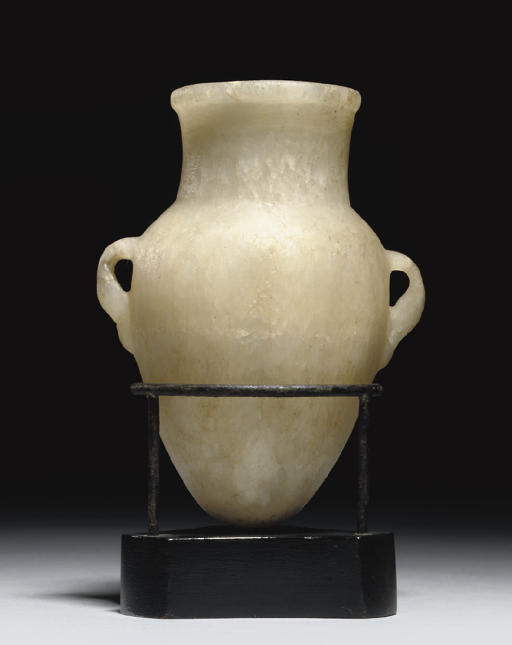

The woman with her alabaster jar walked into the room in full view of the guests and made her way around the table until she stood behind Jesus. There she took her stand, weeping, and began to shower his feet, drenching them with her tears. She was wiping them dry with her hair. And she was kissing his feet and anointing them with the perfume.
The host, taking it all in, says to himself, "He's no prophet! Or he would know what sort of woman is touching him (7:39, hapto, most often of people "grabbing" Jesus, hoping he will "touch" and heal them: e.g., Luke 5:13; 6:19; 7:14; 8:16, 44-47; 11:33; 15:8; 18:15; and 22:51). This is nothing new or out of the ordinary to Jesus. People in need are always grabbing for him. Parents are always bringing their babies to him so that he may touch them. But this woman's a sinner! (harmotolos, see 5:30, 32) Jesus was always being accused of fraternizing with sinners and publicans by the Pharisees; yet, whose table is he sharing today?
Jesus turns to his host and says, "Simon, I have something to say to you." Now we get to glimpse the guise under which Jesus has been invited, because Simon responds, "Go ahead, teacher!" (didaskalos)
Jesus offers an after-dinner parable:


A man who owed (chreopheiletai $500,000 and a man who owed $50,000 both had their loans re-negotiated with the bank (see Luke 16:5). (charizomai, generously, graciously, forgave and pardoned.) Now neither man owes anything, both have unblemished credit scores, and both can keep their houses. Tell me, which will love the banker more?
Jesus replies, "You judge correctly." (Similar to the way the Psalmist prays that God will hear and understand his prayer.) Then Jesus convicts Simon: "Do you see this woman? I entered your house; you gave (didomi, echoing the inability of the debtors to "repay," apodidomi, their obligation) me no water for my feet, but she has bathed my feet with her tears and dried them with her hair." (NRSV, Luke 7:44) Jesus continues enumerating the host's many obligations, a kiss and oil for his head, which Simon had failed to perform. Her many sins have been forgiven, for she loves much. ...and then he trails off, ...but the one who has been forgiven little loves little.
Perhaps the most astonishing thing about the story is the order in which the statements occur. Jesus makes the declarative (objectively real) statement to Simon that the woman's sins have been (perfect! / past) forgiven before he turns to the woman and informs her (subjectively real) that her sins are (now) forgiven (perfect!).

(Image source, http://test.huntmuseum.com/qzty2o/2276.jpg)

(Image source, http://www.carlos.emory.edu/files/05classic05L.jpg)
The other guests are flabbergasted, asking, as will often be the case with Jesus, "who is this who even forgives sins?" Jesus, not missing a beat, says to the woman that it is her faith that has saved her. Her love for Jesus is an expression of the depth of that faith. Her love is deeper, it seems, than the love of Simon, and so is her faith.
How deep is my love?

How much faith do I have?

If our mission is to be/make disciples (it is), we must examine carefully those things that may impede our mission and get in the way of extending help and hospitality. One of those things is fear. Sometimes we fear the angry responses that we may receive from hurting people. But sometimes we also fear our own inadequacy and inability, worrying that we may only make matters worse if we try to help. Because we do not know and cannot know always the full impact of our attempts to help, we may be tempted to avoid those people who are hurting. Instead, we must focus first on meeting the needs of the people whom God sends our way; putting them first--before our fear--is akin to putting Christ first. We must overcome any negative (-) response in ourselves and any fear of a negative response from those whom we would help, so that God's help and grace can triumph (+) over our fear and over the bitterness of hurting people.

The bitter question that a grieving widow and mother asks Elijah is the sort of response we sometimes fear from those in pain whom we would like to help. The woman is understandably bitter and angry. She had been prepared to lose her son to famine when the prophet of God (the man of God, 'ish ha'elohim) had first appeared (I Kings 17:12). The prophet--without invitation--had offered her help and a promise: "thus says the LORD the God of Israel: The jar of meal will not be emptied and the jug of oil will not fail until the day that the LORD sends rain on the earth." (NRSV, I Kings 17:14) That promise must have seemed like salvation to her, especially when the jar of meal and the jug of oil did not run out after the first day and the second and the third. Her confidence, hope, and faith grew. She began to trust the Word of the Lord and the words of the prophet (I Kings 17:16). Now a fate worse than dying with her son suddenly confronts her. The widow's son has died; she must live on alone, so she lashes out at the prophet: "What did I ever do to you, that you come here and expose my sin to kill my son?" (I Kings 17:18) Elijah, instead of taking offense or meeting her bitterness with his own bitterness, takes her son compassionately into his arms and calls out to God on her behalf. Life reenters the boy and new life animates the widow, who says "now I know that you are a man of God and that the word of the LORD from your mouth is the truth ['emet, trustworthy]." (NRSV, I Kings 17:24)
We read again, now from Galatians instead of Acts (9:1-20, Third Sunday of Easter), about Saul's persecution of the followers of the Way and his remarkable conversion. One of my favorite images of Saul the Persecutor is from Fred B. Craddock's sermon, "Praying Through Clenched Teeth" (Twentieth Century Pulpit, Vol. II; also available in Eugene Lowry's How to Preach a Parable

Not too long ago God reached out his hand to bless me and my family. When he did, I looked at his hand; it was covered with scratches. Such is the hand of love, extended to those who are bitter.

As Jesus nears the gates of Nain, he encounters a burial detail removing a corpse from town. It is not just any corpse, but a widow's "only begotten" (monogenes; see Luke 8:42 and 9:38) son who has died. All children are unique, special, and irreplaceable. The loss of an only child to a parent whose childbearing years are over simply underscores and emphasizes the bitterness of such a loss with terrible loneliness and finality. It is right to concentrate on Luke's concatenation of specific descriptors, especially the pairing of a "widow's (kai 'auten en chera) only begotten." It is to this situation in which a woman is left without both husband and son (e.g., Naomi; Ruth 1:5) that Jesus responds with deep compassion (splagchnizomai, like Pharaoh's daughter does as she rescues a crying baby Moses from the Nile basket, Exodus 2:6). In Proverbs 17:5, the LXX adds a contrasting line after the two negative statements that are in the Hebrew text: "Those who mock the poor insult their Maker; those who are glad at calamity will not go unpunished" (NRSV, following the Hebrew) "and the one who shows compassion (episplagchnizomai) will receive mercy" (LXX). Compassion and mercy go together. That is why compassion is forbidden at the destruction of the temple in Ezekiel 24:15-24; until chastisement is over, there is no mercy (and also, therefore, no compassion). Compassion includes the promise of concrete help (e.g., by the Ziphites to Saul when he is chasing David, 1 Samuel 23:21; ironically not shown by Saul at any time to David). This verb for compassion is only used by Luke again at 10:33 (the Good Samaritan) and 15:20 (the father for his Prodigal Son). This should not come as a great shock to those who are familiar with the Lukan narrative.

Jesus tells the widow not to weep (me klaie), an imperative repeated in the NT only at Revelation 5:5 to John, who had begun to despair that the scroll could not be opened. The root occurs, of course, in the Sermon on the Plain. (Luke 6:21, "Blessed are you who weep now, for you will laugh.") It occurs twice more in Luke 7, in the enigmatic saying at 7:32 and in 7:38 with the sinner woman who stood behind Jesus weeping, washing his feet with her tears and drying them with her hair.

At issue throughout this chapter is the identity of Jesus as a Great Prophet (Luke 7:16, 7:22, 7:39). His response to the widow from Nain and the sinner woman are woven of the same cloth: forgiveness and healing, resurrection and salvation.

(Image source, http://upload.wikimedia.org/wikipedia/commons/c/c9/CofSBurningBushLogo.JPG)
[Both the the Church of Scotland and the Presbyterian Church in Ireland, the roots of our own Scotch-Irish Presbyterian churches in the USA, have in their seals and logos this burning bush. It is a symbol of the kirk. The motto of the Presbyterian Church in Ireland is Ardens sed Virens, "burning but flourishing."]

(Image source, http://upload.wikimedia.org/wikipedia/en/7/7e/Pci_burningbush.PNG)

(Image source, http://upload.wikimedia.org/wikipedia/en/8/8a/Presbyterian_church_in_ireland_logo.png)
Perhaps Moses knew the reputation of the place. After all, this was Mt. Horeb, "the mountain of God." Perhaps Moses experienced something like the attraction that children in an old black and white haunted house movie do, who peer through the wrought-iron fence toward an old house that exercises their imaginations. They pass the ever-growing reputation of the place back and forth among themselves in whispers, while daring one another to trespass onto the estate and perhaps even to spend a whole night inside the house. Sooner or later, they see a light shining in a window or out on the grounds, and they are drawn reluctantly but inexorably inside.
(Image source, http://www.cyberhomes.com/CONTENT/Libraries/Blog_Pictures/Haunted_House.sflb)
While Moses has been inspecting the attractive-repulsive phenomenon of the burning bush, God has also been taking stock of Moses. And when Moses gets close enough, God calls out to remind Moses to mind his manners. Moses is not in his own home; he's at God's place. But God's invitation also means that Moses has finally arrived back at home; until now, in Pharaoh's court and in Egypt, Moses has not felt at home or connected to family. Now he is welcomed with a gesture of familiarity and a certain amount of intimacy. Taking off your shoes as a guest in someone else's home meant both that you honored your host--that you would follow the host's rules while you were in their home, receiving their hospitality--but also that you felt comfortable enough (un-threatened, at ease) to accept the familiarity and intimacy of removing your footwear and leaving it at the door.

(Image source, http://wordincarnate.files.wordpress.com/2008/12/burning_bush.jpg)
The more usual scene in classical artwork has Moses closer to the bush, engaged with God, but with his sandals removed and his face covered/shielded, and/or his eyes averted from looking directly at God.

(Image source, http://www.babble.com/CS/blogs/strollerderby/2008/07/01-07/shoes-ath-001.JPG)
For weeks now we've been talking about the need for hospitality--both receiving and offering hospitality--for life as a disciple of Jesus. Today, somewhat unexpectedly, the first thing we run into is another sign of the importance God attaches to what we might consider small acts of welcome and respect. The invitation to take off your shoes is at once both a sign of respect for God's holiness (no need to track up God's floor with the accumulated dirt of our living) and an invitation to make ourselves at home. It is a small act of intimacy (something that strangers, the uninvited, and the unwelcome are not invited to do) that shows respect for someone else's home.

(Image source, http://www.apartmenttherapy.com/uimages/la/102709shoes-01.jpg)
Although Moses would appear to be alone at Mt. Horeb, enjoying a one-on-one visit with God at home--this friendly, cozy scene is disrupted by the return of a vision shared between God and Moses of "the misery" of Hebrew slaves in Egypt, making bricks for the Pharaoh.

(Image source, http://www.mitchellteachers.net/WorldHistory/AncientEgyptNearEastUnit/Images/EgyptDailyLife/AncientEgyptDailyLifeHousingPic_large.jpg)
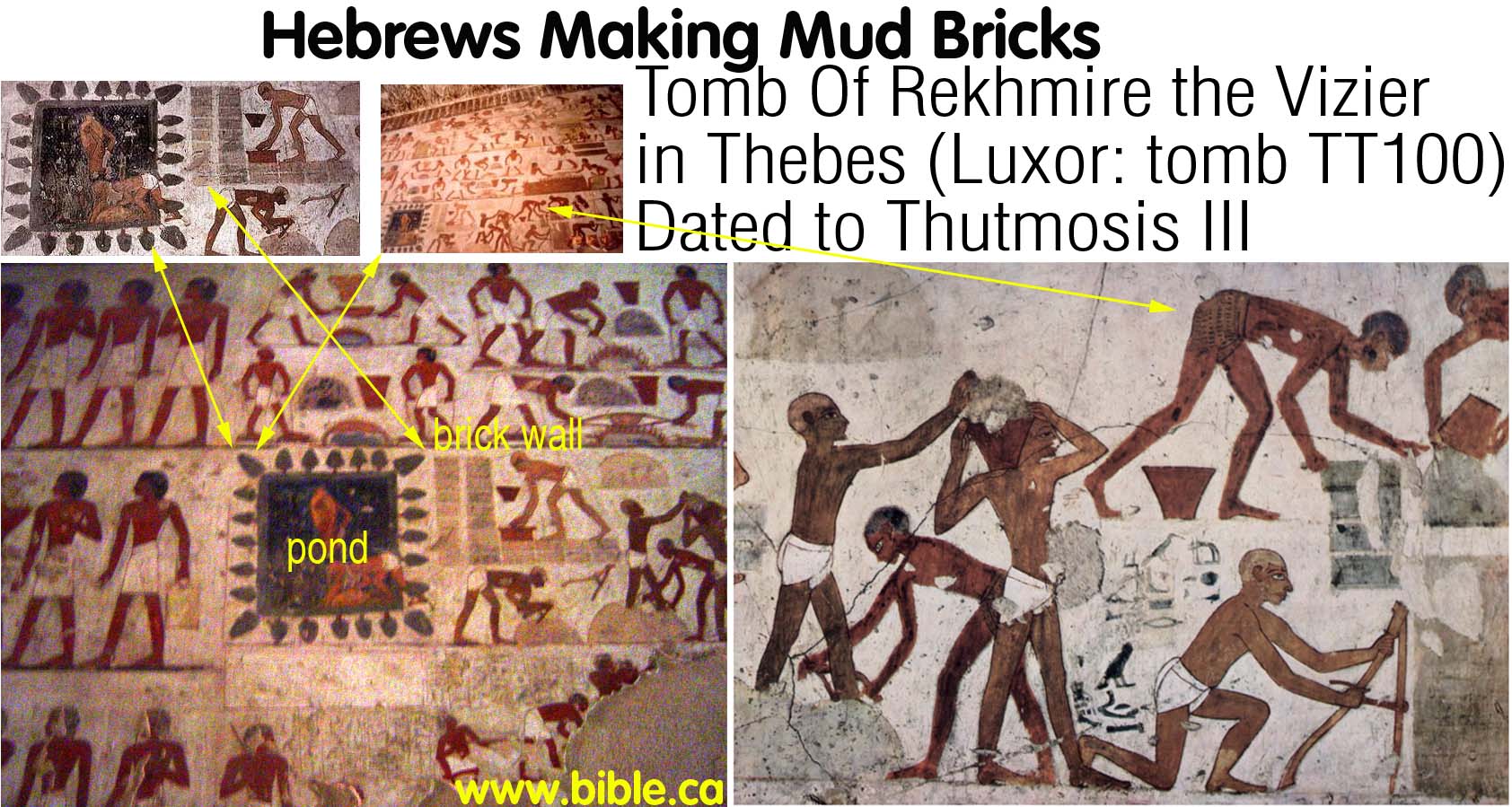
(Image source, http://www.bible.ca/archeology/archeology-TT100-tomb-of-rekhmire-vizier-thutmosisIII-hebrews-making-mud-bricks-thebes-luxor.jpg)
God comes quickly to the point of the visit:
I have observed the misery of my people who are in Egypt; I have heard their cry on account of their taskmasters. Indeed, I know their sufferings, and I have come down to deliver them from the Egyptians, and to bring them up out of that land to a good and broad land, a land flowing with milk and honey, to the country of the Canaanites, the Hittites, the Amorites, the Perizzites, the Hivites, and the Jebusites. The cry of the Israelites has now come to me; I have also seen how the Egyptians oppress them. So come, I will send you to Pharaoh to bring my people, the Israelites, out of Egypt." (Exodus 3:7-10, NRSV)
In other words, God wants to bring his people home to himself and to Canaan.
Moses objects strenuously. He agrees that the work needs to be done, but he objects to the idea that he, Moses, is qualified to do it. (Exodus 3:11) He anticipates that the Israelites will be reluctant to follow. (Exodus 4:1) Moses recognizes his own lack of eloquence. (Exodus 4:10) He even asks God to send someone else. (Exodus 4:13)
God responds directly to each of Moses' objections, providing assurance that the mission is indeed possible with God's help. Though much could be said about each of these assurances, I want to focus on one that most often gets overlooked, the assurance in the interim that he is on the right track, that he has indeed heard the Word of the Lord. That assurance comes as a promise that Moses will return to this very place, and when he does he will not return alone.

(Image source, http://awtravelogues.com/RegionsOfTheWorld/MiddleEast/Exodus%20Photos/MtSinaiValley.jpg)
In other words, God's house, Mt. Horeb, is a place very much on-the-way and in-between slavery in Egypt and life in Canaan. It is an oasis, a way station, a half-way house. It is not Canaan, their final destination, a land "flowing with milk and honey." But it is the mountain of God, Mt. Horeb; it is the place of burning bush and flourishing people. It is a place of escape and regrouping for the next part of their journey with God. They will stay for a little while at the very spot where the burning bush once stood, so that Moses and the people may be reassured that God is the author of their journey and the one who will bring them safely to its conclusion.

 Posts
All Comments
Posts
All Comments