Saturday, December 12, 2009

Sympathy for the Grinch

Last week, Ron Rockey preached about "What Rudolph the Red Knows" as we continued our Advent series Rediscover Christmas: Finding the True Christmas Story in Classic TV Christmas Specials.


Ron reminded us of C. S. Lewis's famous formulation in Surprised by Joy, in the autobiographical account (spiritual autobiography, like Augustine's Confessions) of Lewis's conversion to Christ, that every story (or myth) that is even partly true draws in some way on The One True Story. The Story of Jesus the Christ found in the gospels is, according to Lewis, "the true myth, myth become fact."


[With the recent release of the Narnia films, there has been a spike in interest in Lewis. See "Myth Matters" (for an account of Lewis's 1944 essay, "Myth Became Fact," in God in the Dock: Essays on Theology and Ethics) and see Brent Plate's "Chronicling C.S. Lewis: Marketing and Mythology."]


(Image Source, http://www.nd.edu/~ndethics/images/rotation/inspires/lewis.jpg

Surprised by Joy (the account of 1931, when Lewis would have been 33 years old)

If ever a myth had become fact, had been incarnated, it would be just like this. And nothing else in all literature was just like this. [...] And no person was like the Person it depicted; as real, as recognisable, through all that depth of time, ...yet also numinous, lit by a light from beyond the world, a god. But if a god - we are no longer polytheists - then not a god, but God. Here and here only in all time the myth must have become fact; the Word, flesh; God, Man. This is not 'a religion', nor 'a philosophy'. It is the summing up and actuality of all of them.'
(Surprised by Joy, 1955, pp. 188-189.)


As we heard from the parables (stories) in week one, and as we heard again from Ron about the prophet Isaiah's oracle and the Gospel of John's introit last week, the story of Christ is the Story with a difference. It provokes in us a reaction--not always positive--and it makes a claim to truth and a claim on us at the same time. It is "personally threatening" of our present way of life. It has the potential to transform us. In the words of Gary Dorrien ("The ‘Postmodern’ Barth? The Word of God As True Myth"), "[i]f the Christ [story] is true in the way that it claims to be true, it stands to other [stories] as the fulfillment of their promise and truth. It is not an illustration of mythic truth, but the ground of its possibility and the realization of its fragmentary glimpse of the Real. The question is not whether Christianity is fundamentally mythical, but whether Christ became and fulfilled the great [story].... The old [story] of the Dying God, without ceasing to be [story], comes down from the heaven of legend and imagination to the earth of history." If Isaiah's "child" is the back story (see the "back story" to Rudolph, or Wikipedia's article on Robert May) and the parables are the side stories, then this week we've come to the poetic expression of the story. We've come to sing the blues.


As we said in week one, true stories often, almost always, have stock characters and this week's character shows up every Christmas in many guises and is known by many names: Scrooge, McDuck, Linus, and [drum roll] the gold (actually, green) standard, Dr. Seuss's GRINCH.


How the Grinch Stole Christmas


The Grinch starred first in a 1957 Dr. Seuss book, How the Grinch Stole Christmas!, then in the 1966 TV classic narrated by the spooky Boris Karloff, and finally in a live-action film starring Jim Carrey (directed by Ron Howard) in 2000. (Wikipedia, "Grinch.") The Grinch opens with a scene in which the narrator tries to explain why the Grinch (gasp) does not love Christmas. Is it his shoes that are too tight? Is it his head that isn't screwed on just right? ...or that his heart is two sizes too small? We are threatened and discomfited by the thought of someone who does not love Christmas. There must, there just must be something wrong with such a person.



(Image source, http://web.mit.edu/jonb/www/animate/grinch.jpg)

We cannot understand people who do not like Christmas. In fact we are scared of them; they appear like monsters to us, all covered with green fur and their eyes shining bright red. We are afraid that if we let them get too close, they will succeed in "stealing" Christmas from us. We are afraid that they'll keep Christmas from coming, not just for them but also for us. We want them to keep their distance. They make us feel uncomfortable, so we avoid them especially at this time of year, afraid that they'll ruin our Christmas spirit and rob us of our Christmas cheer. Especially on this third Sunday of Advent, when the pink candle of Joy is burning bright, we do not want their candle-snuffing scowls to darken our mood. So, we exile such people to their cave on Mt. Crumpit. We banish them from our celebrations. In the words of Isaiah, we avert our faces from them. (Now there's an irony for people who say they want to experience Christmas.) Perhaps if we do not acknowledge the Grinches, so we think, their power over Christmas will be diminished. Their negative reaction to Christmas is, at best, perplexing to us--at its worst, nightmarish; it terrifies us.


(Image source, http://www.pragmatik.org/blog/wp-content/uploads/one/grinch_1206.jpg)

We do not often stop to think what our beloved "Christmas season" does to the Grinch and why. We should begin, as Seuss does, by acknowledging how thoroughly Christmas permeates our world. There's hardly any escaping it in the U.S. The Trifecta of Religion, Culture, and Economics means that the air this time of year is saturated with the sights, sounds, smells, and expectation of Christmas. The rituals of Christmas are all encompassing. Grinches, however much they try to remove themselves from the noise, cannot escape the sound of the singing. Where can they go to be free of the jollies? Certainly not to church. At the job there are Christmas parties or invitations to dinners, and inquiries about their plans for Christmas. Nor dare they go within a mile of a mall. They cannot turn on the radio or the TV. A bookstore is out of the question; even the library displays are Christmas themed. They cannot join polite conversations at school or plan a night out at the symphony. For the next few weeks it is all Christmas all the time--24/7 everywhere you turn. You cannot even drive down the street without being accosted on the right and the left by the bright yard-art lights and inflatable manger scenes. Tinsel, White Christmas and Chestnuts, Ho, Ho, Ho!


There is strong power in this story. Because it is ubiquitous, a part of the air we breathe, it is all-the-more rich and meaningful for those who are able to participate. But it also carries a strong dark side. There's no escaping Christmas for the Grinch. Christmas is coming, like it or not.


Our culture provides a template, a blueprint, for the perfect Christmas. There is snow, of course, and chestnuts roasting. (How many of you have ever really tasted a roasted chestnut?)


(Image source, http://meta-dad.com/wp-content/themes/images/classic_christmas_scene.jpg)

Our culture dictates to us what to do, what to feel, how to act, what to say, what to think about Christmas. At the center of it all is the home. Say it with me: There's No Place Like Home for the Holidays! But that is also where our reality collides with the cultural expectations. Despite what the romantic Christmas tunes tell us, despite Delilah and John Tesh or the Hallmark channel, many of us will not have the Norman Rockwell storybook Christmas. And for those whose reality does not match the cultural expectations, the gap is sometimes painfully obvious. They think about what Christmas "should" be, compare it to what it has been or will be, and they scowl. Though there are many areas in which people experience the gaps between the ideal and real celebration of Christmas--for example, the experience of economic hardship amidst the cultural materialism of the holiday season, or the depression caused by shorter days and longer nights and cold, overcast winter skies--there are three gaps related to our experience of Christmas with family that should be highlighted:


Cultural Expectations vs Reality


  • We have the expectation that Christmas will be shared with loved ones, especially close loved ones--mom, dad, son, daughter, spouse, sisters and brothers. But for many of us, especially those who have lost loved ones this year, the reality will be painfully different. Christmas will not bring additional memories to cherish, only the renewed sense of loss. If the loss of a spouse or mom or dad was two or three years ago, friends will expect that the pain of loss will have lessened this Christmas, but all too often the cultural trappings and preparations for Christmas will serve as a sharp reminder that a loved one is not here any longer. We expect such grief to go away after a Christmas or two, but it never really goes away. Is it any wonder that someone who has lost a loved one this year might want to stop Christmas from coming? (These are those who, in Luke's words, "sit in the shadow of death." Luke says the real "reason for the season" is to bring them salvation.)
  • We have the expectation that Christmas will be shared with the "perfect" family--a mom and a dad, 2.5 children, uncles and aunts, grandpas and grandmas. The reality is that divorce and strained relationships, long distances and cultural divides will shatter the "perfect" family. The group with whom many gather will be smaller than the "ideal" and composed differently than expected. And when ours isn't the "perfect" family, is it any wonder we sometimes respond with a scowl?
  • We have the expectation, whether our family looks the part of a "perfect" family or not, that we will at least get along for one day. But all too often we do not act the idealized parts. We bring the pain of strained relationships home; we renew old conflicts; we play out old fights. Is it any wonder that some of us greet the prospect of this Christmas with a frown?

Isaiah spoke of the coming one as one from whom others hide their faces. In this season, most of all, we are tempted to stay away--to keep our distance--from the Grinches, scared that they will spoil our Christmas, rather than making it full and complete. We are scared they may really succeed in keeping Christmas from coming! Isaiah sang to those who were in captivity, not about a White Christmas, but a Blue Christmas. What if Isaiah's message about the Christ--that he identifies with Grinches, that he became a Grinch--was more a part of our message about the season? Before Christmas can ever be a story of triumph (as it is in our cultural ideal), it must be one of compassion. Zechariah too sings the Blues at Christmas. God's heart breaks for his children; God knows and embraces their suffering, accepts and embraces those who are suffering, doesn't dismiss them or hide his face from them.


If our Christmas story is only a story of sugar plums and candy canes--if all is rosy and bright--then we have missed the TRUE story, the REAL story of Christmas.


Maybe it will help to remember that the Magi brought three gifts, two of celebration (gold and frankincense), but also one for mourning (myrrh), a spice for burial.


Even at Christmas (especially at Christmas), we must remember that the cross-symbol, a shadowy hint of the brokenness and tragedy of life, already darkens the manger scene.

From the Manger to the Cross

That's why he comes, to give light to those who sit in darkness. If we do not make space for pain in this holiday, then we miss the richer, fuller, deeper meaning of Christmas. How do we make that space? How do we create that room to enlarge our own hearts? by acknowledging the presence of the Grinches. By acknowledging where they are and how they feel about the season. By being especially sensitive. By having our radar up. (It is easy to hear the holiday sounds, but harder to hear the crying at this time of year.) We must listen, care, try to understand, pray for, make space for, say a kind word to, and send a card to the Grinch. Somehow, some way, we must let the Grinches know that we accept them as they are--green fur, red eyes, scowls and all. You may recall Cindy Loo Hoo. Cindy saw the Grinch as a real person. She did not turn away or hide her face from him. She extended a hand and offered a gift even as he was trying his best to stop Christmas from coming. Cindy Loo Hoo planted the seed that became full-fledged transformation on Christmas morning.


(Image source, http://static.tvguide.com/MediaBin/Galleries/Shows/G_L/Hi_Hp/HowTheGrinchStoleChristmas/grinch-stole-christmas4.jpg)

We all know and remember that the Grinch was healed, that his heart grew three times larger and more that day, but the people of the town of Whoville were also transformed. Their hearts were also expanded. They learned a fullness to Christmas that they had never before experienced--a Christmas that included the Grinch.


(Image source, http://craftmemorial.lib.wv.us/images/grinchfeast.jpg)

They learned that Christmas comes with or without the ribbons and bows, that they can sing with or without the jing tinglers and floofloovers--that it comes both to Whos and to Grinches. That it comes whether you are saying "I can't wait" or "I wish it wouldn't."

Grinches, those who are in darkness and pain, are the reason Christ came. The well do not need a physician.


Luke 1:67-79


It is to those "who sit in darkness and in the shadow of death" (1:79) that the light of Christmas comes. It is to those who, for whatever reason, don't want Christmas to come--who want to keep Christmas from coming at all--that it comes relentlessly, because they need it most. They cannot stop his coming. To them peace, hope, love and joy are promised. They are the ones Surprised by Joy, by love's irresistible force.


Isaiah 53:1-5


The one who sympathizes with those whom society labels as villains, outsiders, oddities, and sociopaths is the one who authors Christmas. He is the one who shares the experience of many who are quietly among us. He knows the gap between the expectation of happiness and the reality of tears, pain, sorrow and grief. He knows what it is to have people hide their faces from his suffering, to be ignored, avoided, and shunned. He is "acquainted with infirmity."


Other Preachers' Themes:


It probably does not come as a surprise that this sermon and similar series have been done many times and is not original to me and my Covenant Group (see previous blog entry). So, I did a little investigating and found other preachers using the Grinch story to good advantage. For example,


Saturday, November 28, 2009

It's a Wonderful Life

Rediscover the True Meaning of Christmas in the Classic TV Christmas Specials


(See Midnight Oil, below.)

Some of my pastor friends will accuse me of having crossed over to the dark side to join in the crass commercialization of Christmas, but I beg to differ. The idea for this sermon series, and the series itself as it has thus far been developed, was the brainchild of one of the pastors in my *covenant group. It has since been preached by all of us (or almost all) except me--and, purportedly, with good results. As the pastors in our group have taken it on in turn, the ideas and resources have accumulated (including some from pastors who have independently developed similar series, and now there are also some available from professional media resources like Midnight Oil Productions), demonstrating what fertile ground there is here. Another pastor friend of mine is always reminding me to meet my congregation on any given Sunday "right where they are." At this time of year, we are completely inundated with media messages about Christmas. Very soon, each and every TV special in the series will be shown, most more than once, on multiple TV broadcast and cable channels. A quick walk into the local department "super-" store (WalMart [TM], Target [TM], etc.) will reveal that these movies are the ones at the top of the shelves--they are the moving images and sounds that create the atmosphere, the context and background for our holiday preparations and family celebrations for the next month. They will be the source of late night jokes, casual references, and allusions in news stories.


Not that we'll be buying everything they are selling. We aren't and we won't. But if we needed some legitimation for preaching the gospel in this mode, we couldn't do better than appeal to Jesus himself. The stock characters and situations in many of Jesus' parables likely originated in the moral and ethical culture in which he was born and grew up. If there had been classic movies in Jesus' childhood, I'm sure he would have used them. When Jesus began to tell the story about the profligate (prodigal) son, for example, everyone around him probably nodded their appreciation, perhaps even predicting that the boy would wind up in a pig pen.


(Image source, http://d1shzm2uca9f83.cloudfront.net/large/remb_vz_varken.jpg)

They had heard this story before. The recognized the characters and the plot. Maybe they could even predict the young man's remorse, his repentance and his return home. But I doubt very much that they predicted the reception with which his father greeted him, or the upheaval in the older brother's expectations. (Luke 15:11-32)


(Image source, http://www.jneiman.com/images/058-prodigal-son.jpg)

Or, to cite another, when Jesus started out a story by telling his audience that "a man was going down from Jerusalem to Jericho,"


(Image source, http://farm3.static.flickr.com/2121/2314500564_fc8ff751a6.jpg)

they may have been able to finish the first sentence without any help: "and fell into the hands of robbers, who stripped him, beat him, and went away, leaving him half dead." People traveling that road were always being mugged. But how many times had their version of the story ended with a Good Samaritan's good deed? (Luke 10:30-37)


(Image source, http://www.wwoaw.net/The%20Good%20Samaritan%20after%20van%20Gogh%20and%20Delacroix%201024%2080.JPG)


As we pursue the telling of the Advent Gospel of expectancy as it appears in the characters and situations of the TV Christmas Classics, we will be on the alert, identifying both where the movies have and, perhaps more importantly, where they haven't followed the twists and turns of the Christmas Story from which they often draw their inspiration.


There are too many such classic movies for any one 4- or 5-week sermon series. I have seen all of the following movies suggested and used more-or-less to good effect: Rudolph the Red Nosed Reindeer, It's a Wonderful Life, Frosty the Snowman, How the Grinch Stole Christmas, Santa Claus is Comin' to Town, Jack Frost (a character in several of the animated classics), The Year without a Santa Claus, The Little Drummer Boy, and A Charlie Brown Christmas.


This year, we will be looking at 5 of the classics (4 Sundays of Advent + Christmas Eve).

November 29, It's a Wonderful Life

Zephaniah 3:14-20, Matthew 20:1-16

December 6, What Rudolph the Red Knows

Isaiah 9:2-7, John 1:1-18

December 13, Sympathy for the Grinch

Isaiah 53:1-5, Luke 1:67-79

December 20, Santa's Cause is Something Profound

Isaiah 60:1-7, Matthew 2:1-12

Christmas Eve, 7:00 pm

December 24, A Charlie Brown Christmas Eve


I'll blog a few ideas about the series each week, beginning now with the 1936 Frank Capra classic, It's a Wonderful Life (60th Anniversary Edition), starring James Stewart and Donna Reed.


Plot Summary, Wikipedia Summary.


What themes from the true meaning of Christmas appear in the movie?

  • Humility and Self Sacrifice, for the sake of others. (Philippians 2:5-11)

    Saint Augustine of Hippo (354-430), in a famous Christmas Sermon (Sermon 187), rings the changes on this aspect of the Christmas story in his own inimitable way: "Maker of the sun, He is made under the sun. In the Father he remains, From his mother he goes forth. Creator of heaven and earth, He was born on earth under heaven. Unspeakably wise, He is wisely speechless. Filling the world, He lies in a manger. Ruler of the stars, He nurses at his mother's bosom. He is both great in the nature of God, and small in the form of a servant." (Translation source, "Reflections," Christianity Today, Vol. 41, no. 14, Dec. 8, 1997)


    No less a preaching light than C.H. Spurgeon could fill a whole sermon (and then some) with reflections on the fact that there was "No Room for Christ in the Inn." Many others have done the same, drawing on images old and new to illustrate the sort of humility that Christ took on.

    In the movie, George Bailey planned all his life to travel the world, to go to "Italy, Greece, the Parthenon, the Coliseum.” He plans when he returns from his world tour to attend college. Then, he’s going to “build things… airfields, skyscrapers a hundred stories high…bridges a mile long.”


    (Image source, http://nighthawknews.files.wordpress.com/2009/07/its_a_wonderful_life_02.jpg)

    One by one, George turns all these things down. Eventually he also turns down Mr. Potter’s outrageous offer of a lucrative $20,000/yr. salary – a salary that would more than have provided for his future wife and children.


    (The evil millionaire, Mr. Potter. Image source, http://avltheatre.com/ruben/potter.jpg)

    On the day of his wedding/honeymoon with bride Mary [!], on his way out of town [once again!], there’s a run on the bank. People are panicking like it's 1933, and they want their money.


    (Jimmy Stewart in "It's a Wonderful Life, image source: http://open.salon.com/blog/megan_stewart/2009/01/07/files/jamesstewart4601231343406.jpg)

    (Oh, wait, it probably is 1933 or thereabouts, because of the flashback from the final setting: Christmas Eve, 1946; George and Mary married in 1928.) The evil millionaire Mr. Potter sees this as his opportunity to take over the bank, and the town. Once again, George lets go of his rights and lays down his life so he can serve the townspeople – by using all but $2.00 of his honeymoon money to save the bank from collapse. In other words, George Bailey spends his entire life giving up his big dreams for the good of Bedford Falls.


  • Why do bad things happen to good people?

    OR
  • Does my life really make a difference? Does it matter at all that I lived? (Job 3:3)

    The title, or subtitle of this sermon might be, "Living a Life that Counts for All Eternity." The movie was, after all, loosely based on the short story "The Greatest Gift" by Philip Van Doren Stern. On Christmas Eve of 1946, George is broken and suicidal over the misplacing of an $8000 loan (lost by his Uncle Billy while bragging about brother Harry's accomplishments and recognition in the war) and the evil schemes of his nemesis, Mr. Potter. George crashes his car into a tree during a snowstorm and runs to a nearby bridge to commit suicide, feeling he is "worth more dead than alive" because of a $15,000 life insurance policy.


    (Image Source, http://esl-bits.net/scripts/WonderfulLife/images/wl_100208.jpg)

    George's guardian angel, Clarence, comes to earth to show George how his town, family, and friends would turn out if he had never been born. George has meant so much to so many people; should he really now just throw it all away? The angel, Clarence, shows George throughout how his town, his family, and his friends would have turned out if he had never been born. George meant so much to so many people; should he really just throw it all away?


  • A Reversal of Fortune (Zephaniah 3:14-20, Matthew 20:1-16)

    After Clarence shows George what life would have been like for so many others if he had not been born (Bedford Falls = a slum, Pottersville; Mr. Gower in prison; Uncle Billy in an insane asylum; Harry dead), George prays to live again. Meanwhile the whole town has also been praying for George. His friends and family have collected a huge amount of money to rescue him. His brother Harry arrives just in time to propose a toast to his brother, "the richest man in town." Seeing how many lives he has touched, and the difference he has made, George Bailey truly does have "a wonderful life."


    (Image source, http://www.calendarlive.com/media/photo/2006-12/27020557.jpg)

The comparisons with the parable of the Laborers in the Vineyard in Matthew 20:1-16 are somewhat obvious. Jesus' parable is bracketed (19:30 and 20:16) with statements about reversals of place and situation in life: "the first shall be last and the last shall be first." Like an oldest male child (and like George), these first disciples--and especially Peter, James, and John (20:21)--are acutely aware of what they have sacrificed to take on the responsibilities they hold. ("We have left everything to follow you, so what will we have?") That is the set up, the context for Jesus' telling of the parable. The eldest child, the first disciples, and the first workers understand there to be an implicit agreement that the return will be commensurate with the investment of time and labor, that those who work and give more will also get more. But Jesus says that the one who bears ultimate responsibility will also pay the ultimate price (20:17-18). The reward, resurrection life, only comes after crucifixion death. It is this promise--the turning of bankruptcy to restored fortune, shame to praise, oppression to benefaction, mourning song and funeral dirge to festival music and dancing, rejection to acceptance, exhaustion to renewed and inexhaustible capacity for living, hate to love, sorrow to joy and gladness, conflict to reconciliation, judgment and condemnation to redemption and grace, enemies to friends, and disaster to salvation--that is the theme of the song of joy in Zephaniah 3:14-20. The last scene of the movie, the last page of the story is one of restoration and salvation for Job, for George, for Israel, for us, for the disciples--all because also for Jesus himself, crucified and resurrected.

*My covenant group is made up of four great friends from seminary days at PTS, David Casson (Sandia Presbyterian Church, Albuquerque, NM), Jeff Chandler (First Presbyterian Church, Bakersfield, CA), John Hartman (Wake Forest Presbyterian Church, Wake Forest, NC), and Stephen Oglesbee (Clear Lake Presbyterian Church, Houston, TX). We meet every year for conversation, study, prayer, ...and sermon series idea exchange! Thanks, guys.

Saturday, November 21, 2009

His Kingdom Is Us?

2 Samuel 23:1-7


It seems somehow fitting that we end the Christian year with the "last words" (dibrey ... ha'acharoniym) of David. If we begin the reading just a verse earlier (2 Samuel 22:51), we also clearly pick up the theme of Christ (meshiycho) the King (malko). God is a tower of salvation for his "king," one who shows steadfast mercy (chesed, loving kindness, covenant loyalty) to his "anointed one." This statement of fact is born out by what follows. David is Israel's quintessential messiah, or anointed king. Now, at the end of his life, the question is whether his last words will bear witness to the truth of the statement about God's faithfulness in 22:51.


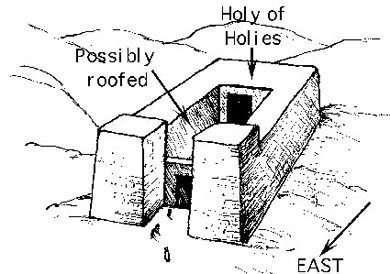
(Image Source, http://www.astarte.com.au/assets/images/sketch.jpg)


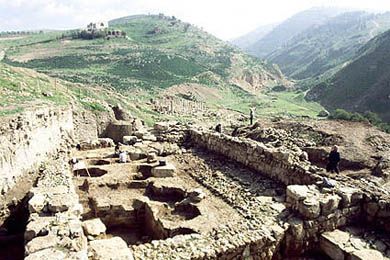
(Image Source, http://www.astarte.com.au/assets/images/Temple2003.JPG)

The LBA "migdol temple" at Pella provides a glimpse of the concrete "tower" of protection provided by the LORD to his anointed, David. (See 1 Samuel 21:1-8, etc.)


David's "last words" are uttered more as a prophet's oracle (ne'um, or like the Wisdom speeches in the Book of Job) than as a king's command. And it is clear that the power of these words is derivative. David is simply "Jesse's son," who has been raised up, anointed, and loved by Israel's God. The words David speaks are not originally his; they are breathed by the LORD (ruach YHWH) and placed like food on David's tongue. David is merely the chosen and anointed messenger, a singer of divine songs, if you will.


(Image Source, http://iamyouasheisme.files.wordpress.com/2008/11/eat_the_book.jpg)

The Spirit of the LORD who speaks through David's lips here (23:2) is not a stranger to the leaders of Israel. The Spirit came upon Othniel and Jephthah, on Sampson and even upon Saul, who was David's predecessor. But none of them was so thoroughly marked by the Spirit for kingship as David. David was Israel's king and anointed one par excellence.


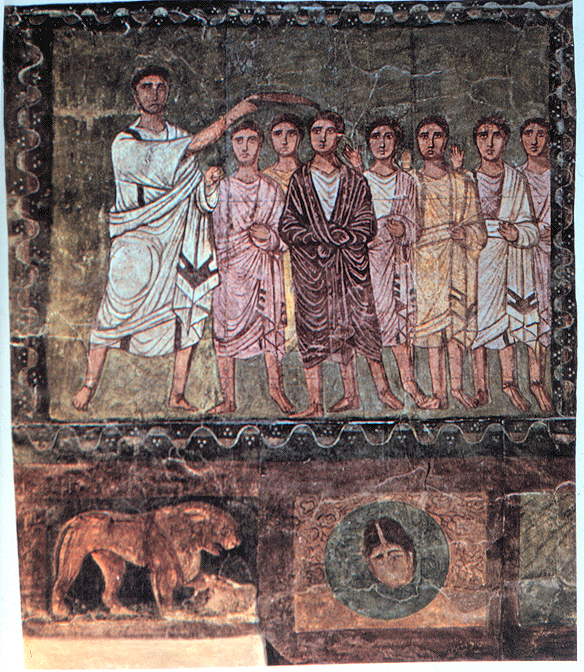
(Dura Europos, Syria. Source: Gill/Gillerman slide collection. Image Source, http://upload.wikimedia.org/wikipedia/commons/d/d4/Samuel_e_david.jpg)

1 Samuel 16:13, "Then Samuel took the horn of oil, and anointed him in the presence of his brothers; and the spirit of the LORD came mightily upon David from that day forward. Samuel then set out and went to Ramah." (NRSV)


Even for kings there is a higher authority to whom they are accountable. There is a right way and a wrong way to rule. Those who rule in accord with universal human rights (ba'adam tsaddiyq) and with reverence toward God (yir'at 'elohiym) are gladly received because of the blessing they bring to their subjects. (23:3)


(Image Source, http://cache.virtualtourist.com/2318769-Morning_light-Walpole.jpg)

Such kings are like the morning light; their advancing presence clears away fear and darkness. Their presence means a day without clouds overhead, a day in which the morning mist glistens on the grass as a brilliantly sparkling display of God's blessing. The morning light allows the dew to linger a while. A morning sun warms but does not scorch. It is a welcome ray that drives away the chill of night. (23:4)


David asks, rhetorically, "Is my house [= my royal family; see II Samuel 7:11-12] not thus with God?" The answer he seeks is "Yes! Of course it is! Long live King David!" And David lines up evidence to support his claim of royal benevolence:

  • God has made an everlasting covenant (beriyt `olam, II Samuel 7) with David and with his descendants. (Would God do that, if David had not been a good king?)
  • God has kept things orderly and rule-y while David has been on the throne. (Despite attempts, there has not been a coup d'état. David has reigned a good long time.)
  • God has (or will) prosper David's help (salvation) and desire (wants).

(23:5)


A worthless [king], on the other hand, is as welcome as a thorn. (Judges 9:7-15)


(Image Source, http://www.hubbo.com/images/2002-05-22/thorny-shrub-close.jpg)

No one wants to get close. No one wants to keep them. (Or their children who come to the throne after them.) Everyone throws them away, because they cannot be held in the hand without getting hurt. (23:6)


(Image Source, https://blogger.googleusercontent.com/img/b/R29vZ2xl/AVvXsEg0_xxCqcgkiGGyQ7v_w2Revxo1NqETKBle-hZ9ox8OKA8O4T6SaZbhe_c0YPuL5_A0QknyALwUQJuO29Y4Oiq5o6MgcSH7XOAwEpBLkzVxT60lOaU0ABezidCpniDDufa3ReS100Jj2ptI/s1600/thorns.jpg and http://www.rosegardeninghelper.com/wp-content/uploads/2009/09/3104TSX418L._SS400_.jpg)

To touch them at all, one uses metal tools, military tools, that can be manipulated from a distance. (23:7)


(Image Source, http://i.ehow.com/images/GlobalPhoto/Articles/4592155/Prunerosebush_Full.jpg)

They are then burnt "on the spot" (bashebet, where they sit: i.e., on the throne).


(Image Source, http://oaksavannas.org/photos/brambles-burning-013.jpg)


David is surely the former rather than the latter sort of king. David has lived, after all, to give his "last words." He has not been deposed and there is every reason to think that his heir will sit on the throne of Israel. The only question is which heir and whether the heir will follow in David's path as a good king or become thorny. But perhaps David's last words protest too much. There were times when David's actions--and those of his heirs--had brought calamity on his subjects. (With Uriah and Bathsheba, for example, 2 Samuel 11 and 12.)


(Image Source, http://restorationupdates.com/advice-tips-and-hints-to-be-restored/repentance-is-absolutely-important/)

But overall the judgment of Scripture is that David was a good king, a good example for future kings, for "rulers" of all sorts (e.g., elders and pastors in churches), and a prophetic glance at what comes next.


Revelation 1:4b-8


The revelation of Jesus Christ makes as clear as can be, as clear as flesh-and-blood, who is the authority behind all earthly authorities, the king of all kings, the "ruler of the kings of the earth." There is a right way and a wrong way to rule. His is the right way. His rule produces for his subjects:

  • Grace
  • Peace
  • Life (from the dead)
  • Faithfulness (the equivalent of chesed, covenant loyalty)
  • Love
  • Freedom

We expect this of a good king, the very best king. We expect that his reign will be long. An eternal covenant or politic can only be maintained by a king (or royal family) who is and was and will be the beginning and the end, the alpha and the omega. What may come as a bigger surprise to us is that we all are his subjects. We are his kingdom. (1:6) We, like David, are his "last words" to the world, priests (more so now than prophets).


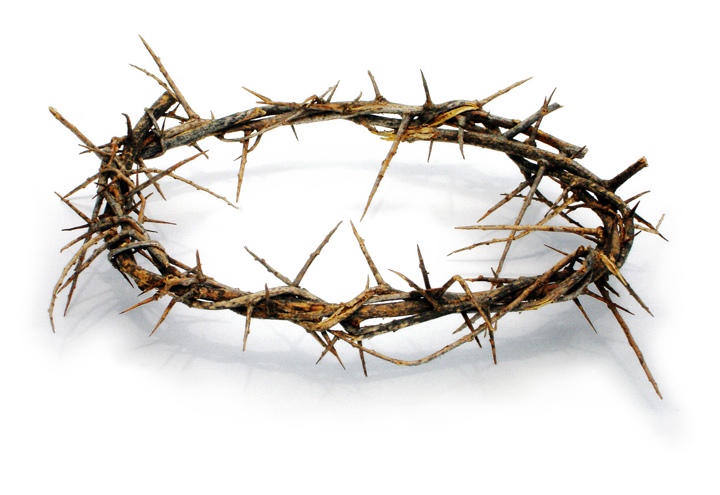
(Image Source, http://frmarkdwhite.files.wordpress.com/2009/02/crown.jpg)

The question is whether we, Christ's heirs (or co-heirs with Christ), will embrace our crown (3:11) and our calling, bringing grace, peace, life, faithfulness, love, and freedom to our world, so that he may be welcomed by all.


John 18:33-37


This scene hardly needs an introduction. Jesus stands in Pilate's headquarters, in front of Pilate's judgment seat (throne), a good ruler under arrest by tyrants. Pilate, an earthly "king," claims to stand outside Jesus' jurisdiction. ("I am not a Jew, am I?")


(Image Source, http://www.cts.edu/ImageLibrary/Images/story/pilate.jpg)

Pilate claims that Jesus' own subjects (your nation and your chief priests) have handed Jesus over to him. The implication seems to be that Jesus is a bad king, if he is indeed a king at all. But Jesus objects that his kingdom is not of this world, not from here. The venue for Jesus' trial--and vindication--is elsewhere. That where seems to be a place where kings embrace thorny subjects and undergo severe punishment so that those they rule may go free. Pilate, perhaps thinking that he has trapped Jesus, says "So you are a king?" Jesus does not answer directly. (Nothing new about that!) But he appeals to the primary attribute and calling of a good king, the ability to judge his subjects on objective (Truth) grounds. A good judge is just ('adam tsaddiyq) and has a great reverence toward (fears) God. Unlike David, whose jurisdiction is limited to Israel, Jesus' reign extends to all who recognize the truth of his "last words."

Saturday, November 14, 2009

Fighting Over Jesus

1 Samuel 1:4-20


Mark 13:1-8


This passage immediately follows the scene of the widow with her two coppers. (Last week's reading, Mark 12:28-34.) For a while now Jesus has been teaching in the temple, saying some provocative things. In Mark 11 he makes his not-too-subtle entry into Jerusalem, borrowing a colt for his purpose with hardly a "by your leave." ("The Lord needs it...," 11:3.) He curses the fig tree. ("May no one ever eat fruit from you again," 11:14.)


(Image source, http://upload.wikimedia.org/wikipedia/en/3/33/Miracleofthefig.jpg)


(Image source, http://www.dkimages.com/discover/previews/795/396066.JPG)

He drives out those who are buying and selling in the temple, overturning the tables of the money changers, not allowing anyone to carry anything through the temple, 11:15-16. When he does finally start teaching, Jesus accuses those to whom he is speaking of turning what should be a house of prayer for all nations (gentiles and Jews) into a den of robbers.


(Image source, http://upload.wikimedia.org/wikipedia/commons/0/0f/Wypedzenie.jpg)


Jesus so angers the leadership with his words and deeds that they want to kill him. Perhaps Jesus is tailoring his message to the crowds (11:18), to provoke their leaders, but the message in private to his disciples is equally provocative (to Peter [11:21ff.], "believe!" and "forgive!"; in private [13:3], some will claim "I am he!"]). Jesus is blatantly confrontational, even combative, seeking to "divide and conquer" the leaders who come to question the authority for his words and actions. His question is designed to produce a civil war. Riddle me this: "Was John's baptism of human origin or was it from God?" And the question produces its desired effect. (11:27-33)


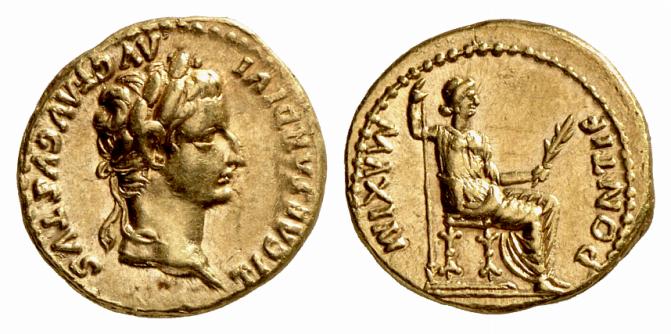
Jesus attacks the leaders obliquely, obscuring his meaning momentarily with parables, but they understand all too well that he is "telling the parable against them." (Mark 12:12) Again they want to arrest him, but put it off. They send instead some smart folks to try to trap him using his own methods, asking him a divisive question: "Is it lawful to pay taxes to the emperor or not? Should we pay them or should we not?"


(Image Source, http://www.romancoins.info/h2005-mint-tiberius2.jpg)

Jesus' answer to their question, based on an inspection of a denarius, punts the ball back to them: "Give to Caesar what belongs to him and to God what belongs to God." After so deftly handling this dispute between the Pharisees and the Herodians, in which he leaves them bickering still about whether to pay taxes, Jesus is asked another litmus-test question by some Sadducees: which of seven brothers will have the barren wife on the day of resurrection? This time Jesus tells his questioners bluntly, not once but twice, that they are quite wrong--and ignorant of the Scriptures. (Mark 12:24, 27)


Another person, a professional, overhearing this dispute between Jesus and the Sadducees, brings to him yet another divisive question: "Which is the greatest commandment?" It so happens that this person agrees with Jesus' answer completely, verbatim. Yes, yes, Jesus, you are so right! And so what does Jesus say? Does he congratulate the man? No. Jesus says, "almost there! You are very near the Kingdom, not very far at all to go now." In other words, "close, but no cigar!" (Mark 12:34) That shut them all up.


Now Jesus, in the temple, turns his attention to the widow woman with two coppers making her way toward the offering plate. (See last week's Bible blog entry.) You might ask how Jesus could ever possibly make a controversial statement about a widow's offering, yet he does: "She has given more than all the rest," he says. (Mark 12:43)


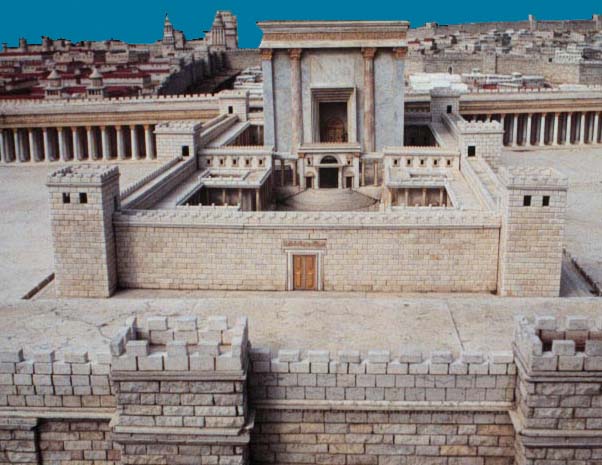
Thankfully, time has now come to leave the temple, before Jesus can stir up even more animosity and trouble. That's where our reading today began.


(Image Source, http://jameswwatts.net/REL%20302%20notes/2TempleModel1.jpg)

On their way out, the disciples remark on the edifice and the stones that went into it; and Jesus, unable to let their comment pass, says "Not one of these stones will be left standing on top of another. All of them will be thrown down flat on the ground." (13:2)


(Image Source, http://adamhamilton.cor.org/wp-content/uploads/2009/03/temple-ruins1.jpg)

Their shock at Jesus' words is evident in the way Peter, James, John, and Andrew huddle with Jesus, expressing their concern. Tell us when; what will be the sign that the things you have said are about to happen? But instead of telling them when it will happen, Jesus gives them a list of signs that the end has not yet happened. (Mark 13:7, 8) There are miles to go before we sleep. Jesus seems to be saying that until the end comes, conflict will be ubiquitous. Wherever we look in our relationships--between nations, between families (and within families!), with nature, in church (wherever!) there will be disagreement, conflict, strife, natural disasters, suffering, pain, and loss. These things will be with us, unavoidably, until the very end. If Jesus, the Son of Man, the Messiah, did not escape it or avoid it but endured it, persevered and even embraced it--where does that leave us, his disciples? If Jesus is headed toward the cross, perhaps his increasing assertiveness in these last few chapters of Mark in the face of those who oppose him is a model for how we are to live in these contentious times. Where and how are we called to account? Asked divisive questions. Pursued with malice because of the way we answer? And especially, where are these things true not just because that's the way life is, but because we follow a troublemaker who isn't willing to let the status quo ante (i.e., death) prevail?

Saturday, November 7, 2009

Poor Providers

In today's texts we meet two "poor providers," Naomi (and her foreign daughter-in-law Ruth) and the unnamed woman who cast the Widow's Mite into the temple treasury.


Ruth 3:1-5; 4:13-17


The widow Naomi declares that she will seek "a resting place" (manoach, NRSV says "some security") for her widowed daughter-in-law, Ruth, so that everything will be OK for Ruth. (She had already blessed both Ruth and Orpah with rest, releasing them to find husbands in their native land; see Ruth 1:9.) Now, until and unless there is a change in Ruth's circumstance, she (and, for that matter, Naomi) is and will continue to be like the dove that Noah released from the window of the ark after the flood, "to-ing and fro-ing," but finding no resting place because all of the landing places are still covered with water. (Genesis 8:9)


(Image source, http://www.josephmillersculpture.com/images/dove-over.jpg)


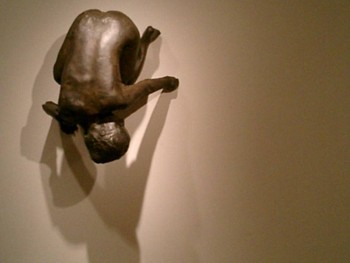
Ruth, the foreigner from Moab, will be lost in Israel just like the people of Israel were once lost in Egypt--and just like exiles who have been dispossessed for reasons of disobedience: scattered from nation to nation, worshiping with strangers, finding no ease, having no resting place, constantly walking without stopping, moving on to avoid the authorities, life constantly in doubt, with heart murmurs, blurry eyes, depression, and a total lack of confidence. Her desperation will become so great that she'll try to sell herself as a slave, but find no takers. (Deuteronomy 28:62-68; see Lamentations 1:3; return to the Land of Promise and settlement there is rest, Joshua 21:43-22:8.)


(Image source, http://archives.starbulletin.com/2007/02/04/editorial/art1x.jpg)


Ruth will be like the driven-out Lilith, finally finding a place of repose. (Isaiah 34:14)


(Image source, http://www.artsjournal.com/artopia/images/kikismith-lilith-1994.jpg)


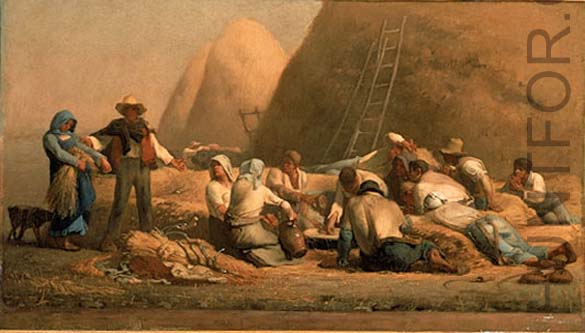
(Image source, http://www.arthistoryarchive.com/arthistory/christian/images/JeanFrancoisMillet-Harvesters-Resting-Ruth-and-Boaz-1850-53.jpg)


Ruth will be like the simple person, inexperienced in the ways of wisdom, who gets into trouble. In desperate straits, in mourning, she will be like the Psalmist who calls out, "the sorrows of death compassed me, and the pains of hell gat hold upon me: I found trouble and sorrow." (KJV, Psalm 116:3) She will be brought low and then saved by God--in this case, Naomi's God--and by Naomi. But when all is said and done, when Naomi has helped her find "some security," Ruth will also be able to pray the thanksgiving portion of the Psalm: "Return, O my soul, to your rest; for the LORD has been good to you." (Psalm 116:6) Naomi and Ruth together are like the ark of God--which travels here and there, and is sometimes captured in a foreign land. It may be viewed as a curse in Philistia, but it scatters blessing wherever it may go in Israel, until it comes finally to rest in Jerusalem during the reign of Ruth's descendant, King David. (1 Chronicles 6:16)


Naomi knows, and shares, the desperate plight of her daughter-in-law Ruth. Given the cultural milieu, Naomi is in fact poorer and more desperate than Ruth. Naomi has an additional disadvantage, her age, which prevents her from childbirth. (Ruth 1:11) But Naomi also has an advantage; she is a native widow. Therefore it takes their cooperation, the sharing of their relative strengths and assets (Ruth's youth and Naomi's pedigree), to move the story toward its redemptive end. Nevertheless, it is Naomi who takes the initiative to provide protection for Ruth (and for herself), an initiative that should rightfully have been taken by the man in the story, the go'el, or near kinsman and redeemer. (Boaz is referred to as "our 'kin,'" moda`at, which is not so precise a connection as to invoke the law of the Levirate Marriage. But note the strong connection to the story of Tamar in Genesis 38; see Ruth 4:12.) Naomi tells Ruth to take advantage of the showers at the shelter in order to make herself presentable, perfuming (How much did that cost? Mark 14:3, John 12:3), and going by night to the threshing floor, concealing herself in a cloak until Boaz has eaten his meal and drunk his wine. (Ruth 3:2-3)


(Image source, http://farm3.static.flickr.com/2348/2280616209_65c78095ee.jpg)


Given the well-known Hebrew euphemisms ("feet" = sexual parts [see Exodus 4:25, Isaiah 6:2] and "lie down" = have sexual relations [too many to cite]), there is clearly a strong sexual innuendo in Ruth 3:4. But the writer never tells us explicitly "what actually happened on the threshing floor." [Gray, Joshua, Judges, and Ruth (New Century Bible), p. 309] That makes for a better story, it holds us in greater suspense.


When the suspense is resolved, Ruth has born a child--for Naomi (Ruth 4:16; compare Hagar and Sarah, Genesis 16). Each woman has been for the other the conduit for God's blessing, receiving in the process more than she has given. There are royal overtones (Psalm 2:7, Isaiah 9:6), which carry through directly (Ruth 4:17) to David and indirectly (Matthew 1, Luke 3) to Jesus. Through each poor widow God has blessed the other, and through the both of them together God has blessed the nation, and indeed the world.


Mark 12:38-44


One of the foremost indictments in Jesus' teaching against the Teachers of the Law is their appetite: they routinely devour the resting places of widows like Naomi and Ruth. They eat the hope of the poor for lunch. According to Jesus, there are certain visible signs of their ilk to beware: fancy dress, the use of honorifics ("The Rev. Dr. ...") in public (especially when wheeling and dealing), seats on the governing board of the church, V.I.P. invitations to awards banquets, and the like. These are things we might expect, but they also pray long prayers, which might come to us as something of a surprise. Jesus' conclusion is that such people will get their just desserts: just as Naomi and Ruth were blessed beyond all rightful expectation, so these Teachers of the Law will be cursed (judged guilty) to excess.


Then begins the story of another widow. Jesus sits down to watch people give their temple offering, throwing coins into the collection plate. ("According to Mishnah, Shekalim , 5 there were in the temple 13 such receptacles in the form of trumpets." BDAG, gazophulakion) The clatter must have been noticeable when the rich folk [the aforementioned "Teachers of the Law"] threw in large amounts. It is hard to think of such an act--giving freely to the temple coffers, and thus to the support of the poor, as in any way destructive, but Jesus has already judged it so. He says they are eating the lunch of the woman who appears next in line. But this unnamed widow has the last laugh. Her two coppers together amount to less than a penny; they hardly make a noise as they hit the plate. The disciples, their attention drawn elsewhere, must be summoned to pay attention to the widow. She has given more than all the others who are throwing coins into the plate, Jesus says. They gave the overflow, the parts they didn't need or want. Every cent she gave, she needed. As a homeless person, she gave up her last little bit of security, her last place to rest, her very life.


(Image source, http://www.romanorum.com.au/Info/Articles/Forming%20a%20Collection/Forming%20a%20collection/Bolden-Widows%20mite.jpg)


It is hard to see how, or where, or when this woman has her life restored to her. Certainly the "Teachers of the Law" are not going to help her. I think Jesus must be looking after her like Naomi looked after Ruth, one homeless person helping another, one penniless sojourner staying awake, guarding the underpass while the other catches a moment of sleep. Like Ruth looking at Naomi, Jesus sees something in this widow that reminds him of his Father. By sharing, like the boy with the loaves and fishes, miraculously all are loved: saved, healed, and fed by God's grace.


(Image source, http://www.wcg.org/lit/images/b9/WidowsMite.jpg)


Where does that leave us? In part, we are surely indicted like the "Teachers of the Law." Very few of us by any stretch of the imagination are "widowed" in the sense that these widows were, without even a place to rest, without "some security," Social Security or otherwise. But we are all also experienced in loss and are more or less aware of the severe limits placed on us in this life. As such, we need the sort of help that Naomi gave to Ruth, the help of others who share our plight, and the help of one other in particular, Jesus the Christ.

Saturday, September 19, 2009

A "New" House

Renovation, Open House, Rededication


This Sunday we are leaving the lectionary, and it will be a month or so until we pick it up again. Our first departure, the text for this week, is occasioned by a celebration of the completion of a complete renovation of the church building, with priorities on improving hospitality and ministry to families with children 12 and under, and to address some delayed maintenance issues.


(Source, http://tumbledownfarm.shutterfly.com/32)

You can read the announcement at the Southminster web site, open house, http://www.southminster-pcusa.org/drupal/News/Open_House_09022009.


It seems appropriate to begin with the well-known quote of Winston Churchill about buildings and their effects: "On the night of May 10, 1941, with one of the last bombs of the last serious raid, our House of Commons was destroyed by the violence of the enemy, and we have now to consider whether we should build it up again,and how, and when. We shape our buildings, and afterwards our buildings shape us. Having dwelt and served for more than forty years in the late Chamber, and having derived very great pleasure and advantage therefrom, I, naturally, should like to see it restored in all essentials to its old form, convenience and dignity." -WSC, 28 October 1943 to the House of Commons (meeting in the House of Lords).

(Source, a .pdf file, http://ocw.mit.edu/NR/rdonlyres/Sloan-School-of-Management/15-310Managerial-Psychology-LaboratorySpring2003/6F5D40DC-478B-4DC3-8ECE-973746576CCB/0/lecture21a.pdf

According to the notes attached to that 2003 presentation to the Sloan School of Management (op cit.), "The old House of Commons was rebuilt in 1950 in its old form,
remaining insufficient to seat all its members. Churchill was against 'giving each member a desk to sit at and a lid to bang' because, he explained, the House would be mostly empty most of the time; whereas, at critical votes and moments, it would fill beyond capacity, with members spilling out into the aisles, in his view a suitable 'sense of crowd and urgency.'"


Churchill's oft-quoted observation suggests the following realities about Southminster's newly renovated facilities:

  • First, that the decisions of our ancestors continue to shape us in profound ways. The Facilities Task Force and Session, when faced with the question whether to "start over" or to renovate the existing facility, consciously chose the latter path. One of the values of that decision is that it preserves a great deal of what we had. In that way the building in which we fellowship, minister, and worship, continues to shape our children in some of the very same ways that it has shaped us.

  • Secondly, we have not significantly increased the size of the building while attempting to multiply our ability to minister to and serve our community. All of our space is now shared space, shared with one another and shared with those to whom we hope to minister. We no longer have any "dedicated" rooms that are just used for one purpose for an hour on a Sunday morning. We share. In Churchill's language, we have refused to give each member "a desk to sit at and a lid to bang," a decision that should lead in a very short while to what Churchill called a "sense of crowd and urgency." If you read Tom Ehrich's piece--"Why let churches sit empty?"--in the Saturday Star this week, you will recognize some of what we have begun to do. It is a return, historically speaking, to a dual function, both secular and sacred, for the whole facility. The one exception, the one space where we had dreamed of extending this new mode of living with one another and with our community, by sharing all of our space--but failed for lack of funds, ability, or will (or all three)--is in the sanctuary. I would suggest that this may be the "unfinished business" of our "Phase I." Jim Kitchens and Baird Dixon ("Up from the Ashes," Call to Worship, vol. 42.1, 2008-2009, p. 45) call this "a functional understanding of the sanctuary, acknowledging that it is a 'holy space' when we gather for the purpose of worship and a space that can be used for other functions at other times."

  • Finally, we have maintained a close proximity between staff, even increasing it in some instances, thus increasing the likelihood of regular communication of important information.

To the extent that we have been able, within the very human constraints of the time, money, and ability with which we had to work, we have tried to shape our building to help us to do two things very well: 1) to welcome our neighbors and to provide excellent hospitality to all who come to Southminster and 2) to minister to families with children ages 12 and under. We did this while trying to preserve the integrity of worship, fellowship, and programs for Christian Education and Youth. The spaces where these other activities happen every week have not gone away; they are simply being shared during the week in a way that will multiply our ability to reach out to others with Christ's love and grace.


2 Samuel 7:1-29


Of course, we aren't talking about shaping a private residence or a secular, public building. We are talking about a building dedicated to religious purposes, a building shaped for the purpose of shaping our relationship with God. We are talking about what has ordinarily been called "the house of God." But, as the prophet makes clear to David, and as Solomon's prayer (below) reiterates, everyone knows that God does not live in a house shaped by human hands. Whatever we build, it is not God's dwelling. No, if you want to be clear about it, God chooses to live in a house that his very own hands have shaped. (Genesis 2:7) God is in some theology known as the unmoved mover, the one not shaped or created by another; God simply is and does. When God made us, God made his own dwelling place. We have fallen into disrepair. We are in need of some divine maintenance to make us habitable again. For that work, Jesus provides the divine plan; Jesus is the blueprint for our home makeover.


That's what the prophet meant when he told David that he should shelve his plans to make a house for God. God doesn't need a house--and if he did, David couldn't build it. God will make David a house, and in doing so will provide a place for God to dwell. God doesn't need a house of cedar. David does. Solomon does. We do. But God does not.


What makes this place God's house? The people who are gathered here in his name, who come together to make a living temple, a house not made with (human) hands; the people of God make this the house of God. In other words, God's hands make this the house of God. Does that mean that we should devalue the church facilities? Should we neglect the physical place where we gather? Should we let it fall into ruin and disrepair? Should we fail to shape it when the opportunity presents itself? Should we fail to make it over to fulfill the mission and vision we have received from God? No! (In good Bible speak, "God forbid!")


David and Solomon understood that the house they built could never contain the God they worshiped. But the house they built could and it would shape the people who came there to pray. For that reason Solomon made it out of the best available materials. He called together (conscripted) the most expert craftsmen and builders, architects and contractors. David, for his part, must have prepared his son to do the work from which David had been barred. Perhaps David collected materials, perhaps he merely planted the vision and nurtured the desire in Solomon to see the very best timbers and stone, gold, silver, and other materials used to build a house for the worship of the Holy One of Israel. Solomon, in his wisdom, put together a Facilities Task Force that was equal to the challenge. And when they were done, they had shaped a house of prayer that would shape the people of Israel for centuries to come.


Solomon's prayer of dedication is a model in this regard. Solomon lays out in prayer before God the most important functions of the temple space; he lists the ways he hopes the temple will shape the peoples' lives. He prays that the temple will do its job as way in which God shapes his people into the sort of home that God desires to live in (1 Kings 8:31-43):

  • "If someone sins against a neighbor and is given an oath to swear, and comes and swears before your altar in this house, then hear in heaven, and act, and judge your servants, condemning the guilty by bringing their conduct on their own head, and vindicating the righteous by rewarding them according to their righteousness.

  • "When your people Israel, having sinned against you,...

  • "When heaven is shut up and there is no rain because they have sinned against you,...

  • "If there is famine in the land, if there is plague, blight, mildew, locust, or caterpillar;...

  • ...so that they may fear you all the days that they live in the land that you gave to our ancestors.

  • "Likewise when a foreigner, who is not of your people Israel, comes from a distant land because of your name -- for they shall hear of your great name, your mighty hand, and your outstretched arm-- when a foreigner comes and prays toward this house, then hear in heaven your dwelling place, and do according to all that the foreigner calls to you, so that all the peoples of the earth may know your name and fear you, as do your people Israel, and so that they may know that your name has been invoked on this house that I have built."

(all NRSV)


House Cleaning and Renovation: Rosh Hashanah and Yom Kippur


It is happy circumstance that Southminster's celebration falls on the Jewish New Year, Rosh Hashanah, 2009, which began at sundown on Friday September 18 and ends at nightfall on Sunday September 20. Yom Kippur follows 10 days later, on September 27. Rosh Hashanah is the time for celebrating the creation of the world, i.e., the "birthday of the world." It is also the time when Israel celebrated the fact that God rules in this world. The simplest way of understanding this aspect of Rosh Hashanah is to imagine that God sits on his throne in heaven and has appointed one day each year in which to pass judgment on the deeds of the past year and determine what will happen next year. Rosh Hashanah (as a season that lasts until Yom Kippur) is that day of judgment; it is the day appointed for the determination of one's destiny. (See Job 1 and 2.) It is also likely that Israel's kings were enthroned (and their kingship renewed) during the New Year celebrations, following a thorough renovation and cleansing of the temple.


The shaping of the temple and its rituals did indeed shape the lives of those who worshiped there. It taught Israel that God is on the throne, that God holds both life and death in his hands, that Israel and its leaders lived for God's will and purpose. That even the kings ruled at God's pleasure, for God's purposes. The cleansing of the temple and its renovation reminded the people of their need for reconciliation with one another and with the God whom they served, whose temple and image they were.


Two things that have been renewed in the Reformed tradition of shaping houses of worship are especially important for shaping us theologically. They are also aspects that Southminster has included in our renovation. They are 1) an attempt to focus on the presence of God, removing as many human distractions as possible and diminishing the self-importance of human performers, and 2) "infusing the [...] sanctuary with natural light and using clear glass windows to connect worshipers to the world into which they are called to serve through their own Christian vocations." (Kitchens and Dixon, p. 41.) Our building shapes our focus on God and our focus on the world which we are called to serve. In that way, God continues to shape us into the house he wants to inhabit.


Note: An interesting article on how our institutions shape us.

Saturday, September 5, 2009

Rich Man, Poor Man

Generosity and Justice, Grace and Righteousness


Proverbs 22:1-2, 8-9, 22-23


22:1-16 is composed of a series of comparisons, specifically contrasts between the path (or life) of a wise person vs. a fool. The compiler of this collection of aphorisms uses antonyms for good and stark effect. There are no shades of gray here, no blurred lines. All is either black or white.


22:1, Contrast, Riches and Reputation


The first contrast is between a tangible good and one that is intangible. Riches are good, but there is something better. The wise person makes the better choice: a [good] name (fame, reputation) and good favor (popularity). The fool sells himself short and settles for money over good personal relationships and the high regard of others. The proverb doesn't give us specific examples, but examples of wise (or blessed) folk in scripture who gained favor with God and with others are: Noah (Genesis 6:8, etc.), Ruth (2:2, 10), and Esther (2:17, 5:8, 7:3). See 1 Samuel 1:18; see also Genesis 11:4 and 12:2 for a cautionary note about establishing one's own reputation vs. a strong faith in God's fulfillment of his promise to establish us.


22:2, Comparison, Rich and Poor


What do a wise person (rich) and a fool (poor) share in common? A single "maker." This proverb includes but goes well beyond the act of initial creation. It avers that the LORD remains in the director's chair, willing and doing his good pleasure. Hence the wise person and the fool will often (always?) have different ends, despite similar beginnings. The wise person embraces and follows God's "doing and making," whereas the fool rebels and tries to reject God's work. The wise becomes rich, the fool is impoverished.


22:3, Contrast, Open and Shut


Caution, road out ahead. (Image Source, http://farm1.static.flickr.com/24/90451693_084e5fd5d1.jpg)

The alliteration (both assonance and consonance) employed in the first three words of this verse is a mark of the literary craft to be found in the whole collection. Note the opening line: `arûm ra´â ra`â, "the wise person sees evil [things]" coming and hides. The word for "a wise person" (`arûm) here is the same word used in Genesis 2:25 (the man and his wife were both "naked" [`árûmmîm] and were not ashamed) and in Genesis 3:1 (the serpent was more "subtil" [`arûm] than any beast of the field). The motif of secret things and secret places, things hidden, is very much in evidence here. The wise can see through obscure things and into dark places; they have advance warning systems and sophisticated radar to detect danger. They proceed with caution. The fool on the other hand is oblivious to even the most obvious warning signs. The big detour that warns of a bridge out ahead is ignored as the fool guns the engine and plunges headlong into a watery grave.


22:4-5, Contrast, Carrot and Stick


The first verse lays out the carrot, the reward, for a life of humility and a genuine fear of (respect for, worship of) the LORD. However, this isn't a case of external manipulation; it isn't a matter of trying to get someone to do something he or she doesn't already want to do. Rather (like the "seed" example to follow in verse 8), this "reward" is actually a built-in consequence; it is the result, or the natural end place, for someone who lives in humility and the fear of the LORD. Such people will naturally wind up with riches, glory, and [long, good] life.


This image shows just how hard it can be to detect a snare. This is very definitely the wrong road to be traveling. (Image Source, http://tumaren.wildlifedirect.org/files/2009/01/snare1.jpg)

On the other hand, sharp, spiny thorns and bird-trap nets seem to sprout up overnight everywhere along the road of the "crook" (crooked, twisted, perverse, perverted, or "froward" [gotta love the King James Version]). Again, this is not an external imposition, a punishment of some sort meted out directly by God. It is safe to say that the "God-fearer" and the "pervert" aren't traveling the same road. If they were, the conditions of the road would be the same. If both were traveling the road of humility, the result would be riches, glory, and life. If both were traveling the crooked path, both would encounter thorns and snares. If you want to keep your life, you'll stay away from the crooked road strewn with thorns and bedeviled by snares.


A net snare for small birds (Maori). (Image Source, http://www.nzetc.org/etexts/Bes02Maor/Bes02Maor482a.jpg)


22:6, Comparison, Young and Old


(Image Source, http://www.baltimoresun.com/media/photo/2008-05/38979882.jpg)

This is perhaps the most famous verse in all of Proverbs, yet nearly every translation obscures the most common meaning of the first word, chanok. In the few other biblical instances of its use, the word means to "dedicate" something (usually a house, or public building) to a particular use (usually holy). It can mean to inaugurate or "baptize" (break-in, initiate). In other words, the point is to put a young person on the right road, at the right starting line, aimed in the right direction...and when he or she finally comes to the end of that road, all will still be well. Dedicate a young person to the right path at the start and the wrong path will not be a problem at the end. Don't put a horse in the starting gate at the Preakness if you are wanting it to cross the finish line in the Kentucky Derby. Some things are by definition impossible. Take care of the starting gate (which is all a parent or teacher can really effect) and the finish line will take care of itself (or, in more theologically straightforward language, God will take care of the finish line).


(Image Source, http://fineartamerica.com/images-medium/finish-line-michael-lee.jpg)

Isaiah 35:4-7a


Psalm 125


Psalm 146


James 2:1-10, (11-13), 14-17


Mark 7:24-37